

Reviews
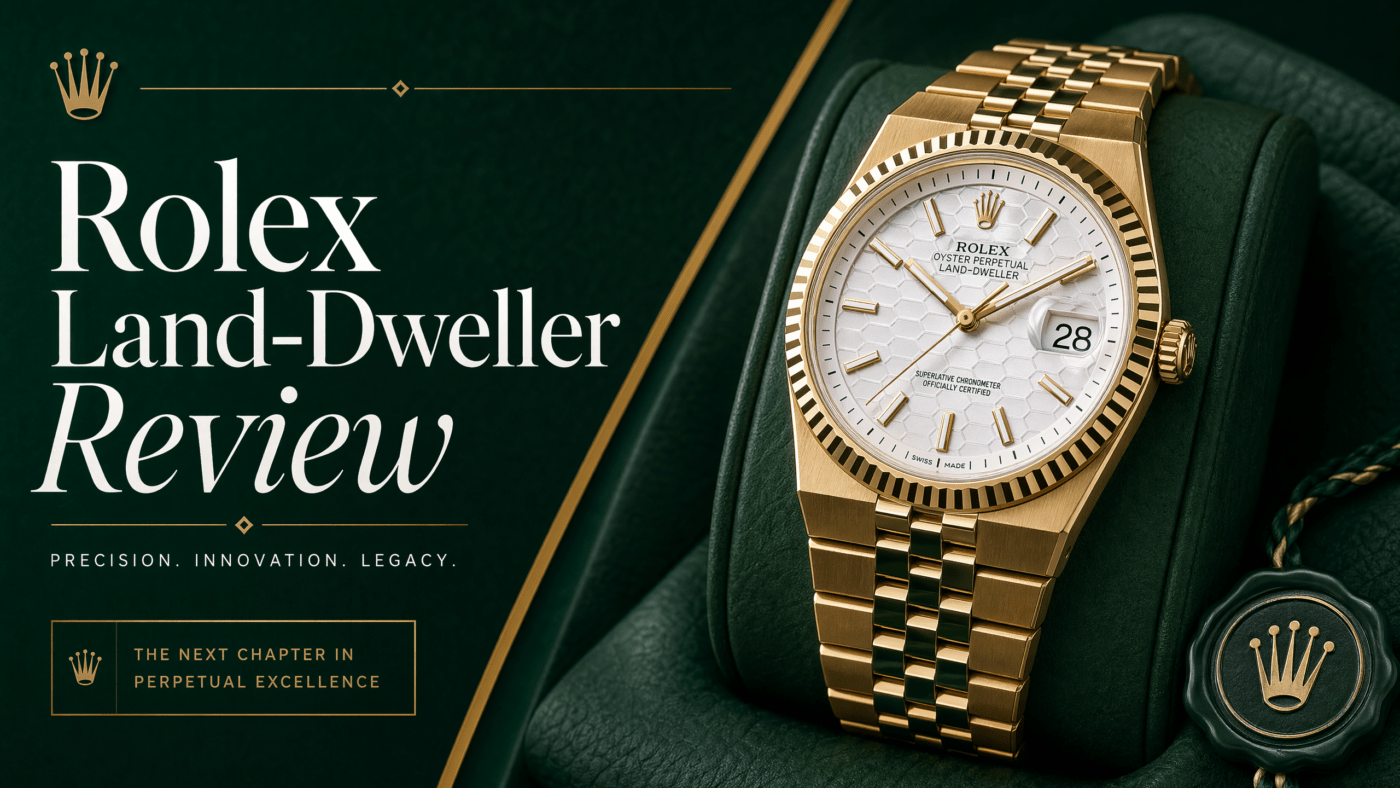
Rolex Land-Dweller Review: The Watch That Rewrites the Rules
Apr
Why the Land-Dweller Matters More Than Any Other Rolex Release This Decade
Rolex doesn’t launch new model families often. The Daytona arrived in 1963, the Explorer in 1953, the Sky-Dweller in 2012. So when the Oyster Perpetual Land-Dweller debuted at Watches & Wonders 2025, it wasn’t just another reference refresh. It was the Geneva giant doing something it almost never does: building a watch from the ground up with a brand-new movement, a brand-new case architecture, and a brand-new bracelet design all at once.
The most talked-about version? The Ref. 127334-0001 in Oystersteel with white gold bezel, 40mm case, and that striking honeycomb-motif dial in intense white. It retails around $14,900, but secondary market prices have been climbing past $85,000 in the months since release — a premium that tells you everything about demand.
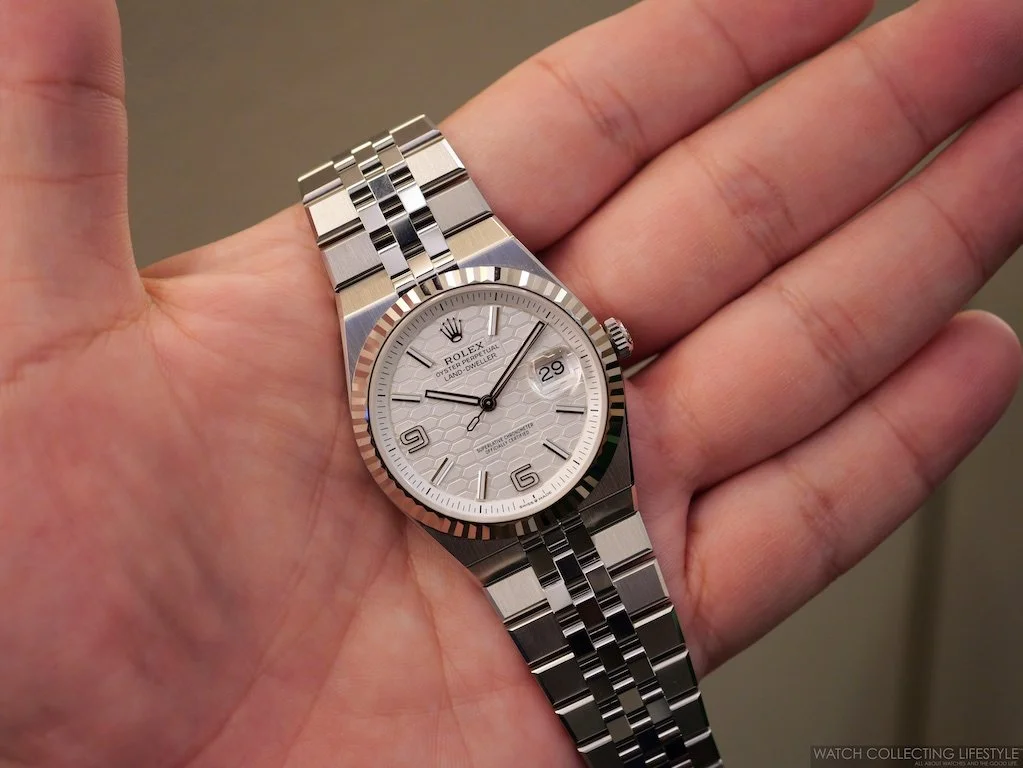
The steel Land-Dweller Ref. 127334 has become the most sought-after variant since its April 2025 launch. Image: WatchCollectingLifestyle
But strip away the hype and the grey-market hysteria, and what you’re left with is a genuinely interesting watch — one that critics have scored as high as 9.125 out of 10, with build quality earning a perfect 10/10 from at least one reviewer who spent extended time with it. This review digs into why.
What Exactly Is the Land-Dweller?
Positioned between the Sea-Dweller and the Sky-Dweller in Rolex’s naming hierarchy, the Land-Dweller occupies a different territory entirely from either. It’s not a deep-diving tool watch, and it’s not an annual calendar complication piece. Instead, Rolex describes it as an everyday luxury watch — their first integrated-bracelet sports watch, drawing design DNA from the vintage Oysterquartz and the obscure ref. 5100 Beta 21 from the early 1970s.
That heritage matters more than most people realize. The ref. 5100 was Rolex’s first — and for decades, only — foray into quartz technology. It was angular, unconventional, and distinctly un-Rolex in its geometry. The Land-Dweller inherits that same willingness to break from the Oyster case orthodoxy, but wraps it in 50 years of manufacturing refinement. There’s a certain poetry in naming it the “Land-Dweller” too. The Sea-Dweller descends into the ocean. The Sky-Dweller tracks multiple time zones for globetrotters. The Land-Dweller? It’s for the rest of us — the people who live on solid ground, go to offices, eat at restaurants, and want a watch that feels special during completely ordinary moments. Rolex has never been this literal about its naming, and the honesty is refreshing.
Available in two case sizes (40mm and 36mm) and across materials ranging from Oystersteel to 18k Everose gold to 950 platinum, the collection covers a wide price spectrum: roughly $13,900 for base steel up to $116,900 for diamond-set platinum. The steel 40mm (Ref. 127334) is the one everyone wants, and the one we’re focusing on here.
Design & Aesthetics: Polarizing, But Purposefully So
Let’s address the elephant in the room. The Land-Dweller’s design has been called polarizing, and that’s fair. The integrated bracelet, the flat case sides, the geometric lugs — it doesn’t look like a Submariner or a Datejust. Good. Rolex has enough watches that look like a Submariner or a Datejust.
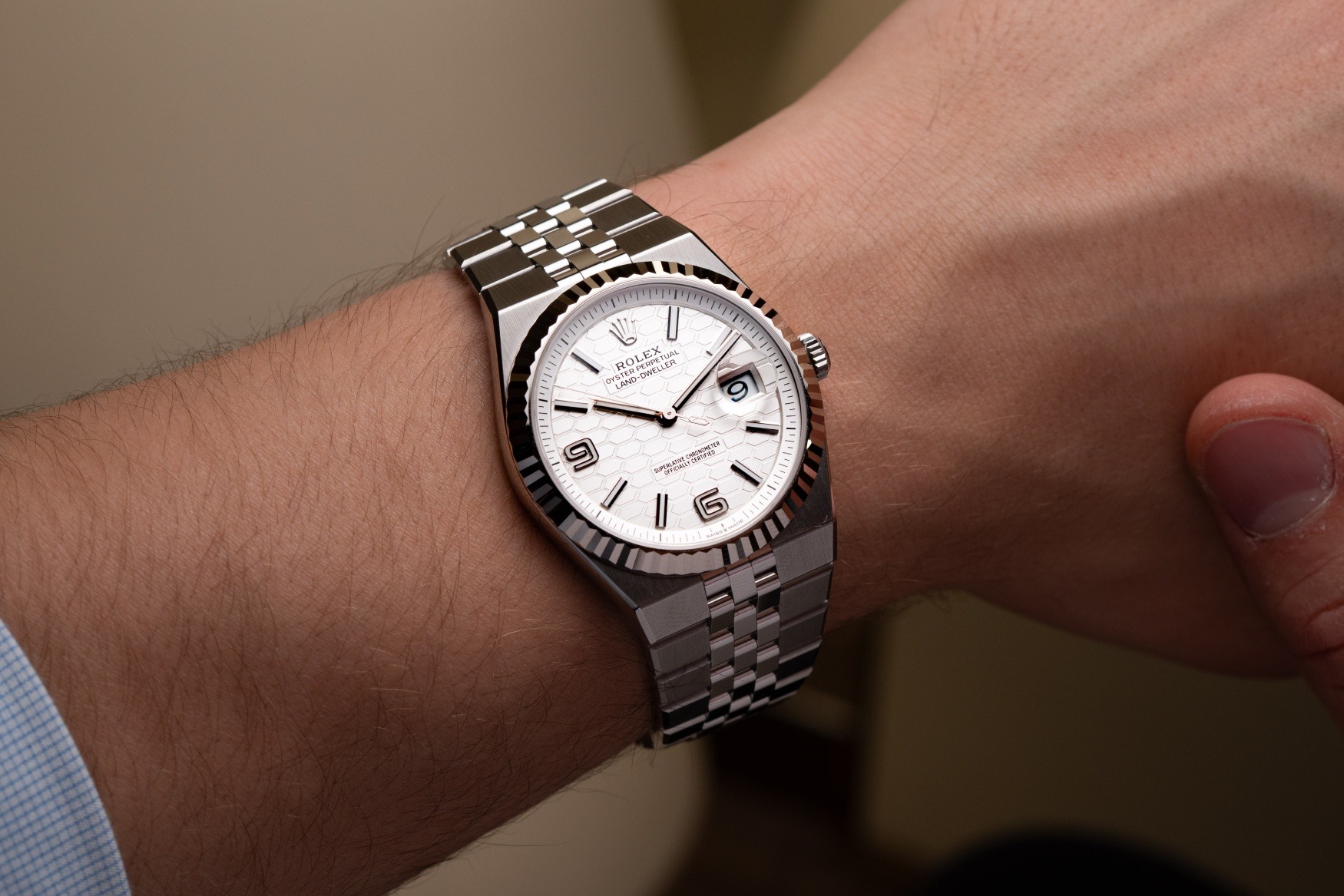
On the wrist, the 9.7mm-thick Land-Dweller wears thinner and more refined than its specs suggest. Image: TimeAndTideWatches
The Honeycomb Dial
The dial is where the Land-Dweller earns its keep visually. Using a proprietary femtosecond laser engraving process, Rolex creates a honeycomb pattern across the entire dial surface that catches and refracts light in a way no other current Rolex dial does. In the intense white version, it reads almost three-dimensional — like looking into a miniature architectural facade.
The ice blue variant (available on platinum models) is even more dramatic, but the white dial on steel is the one you can actually wear daily without it screaming for attention. Applied hour markers and hands feature Chromalight luminescence, and the Cyclops lens sits over the date at 3 o’clock in classic Rolex fashion.
The Flat Jubilee Bracelet
The integrated Flat Jubilee bracelet is arguably the Land-Dweller’s most controversial element. It flows directly from the case middle — no gap, no transition, just a continuous line of polished and brushed five-piece links that wrap around the wrist. The brushing quality has been described as “sublime” by more than one reviewer, and the polished inner links genuinely do look spectacular when the watch is being worn.
The concealed Crownclasp keeps the design clean. No fliplock, no diver’s extension — this is not a tool watch bracelet. It’s a dress bracelet built into a sports watch case, and that tension is part of what makes the Land-Dweller interesting.
Caliber 7135: The Real Reason This Watch Exists
Here’s the thing about most Rolex launches. The exterior changes, the dial gets a new color, the bezel swaps ceramic for something else — but underneath, the movement is usually a slight variation on what came before. The Land-Dweller breaks that pattern completely.
The Caliber 7135 is an entirely new manufacture movement, and it represents Rolex’s most significant technical innovation in decades. It runs at 5 Hz (36,000 beats per hour) — substantially faster than the 4 Hz frequency that nearly every other modern Rolex uses. That higher beat rate translates to smoother sweep of the seconds hand and, more importantly, greater precision. Rolex certifies it as a Superlative Chronometer at +2/-2 seconds per day.
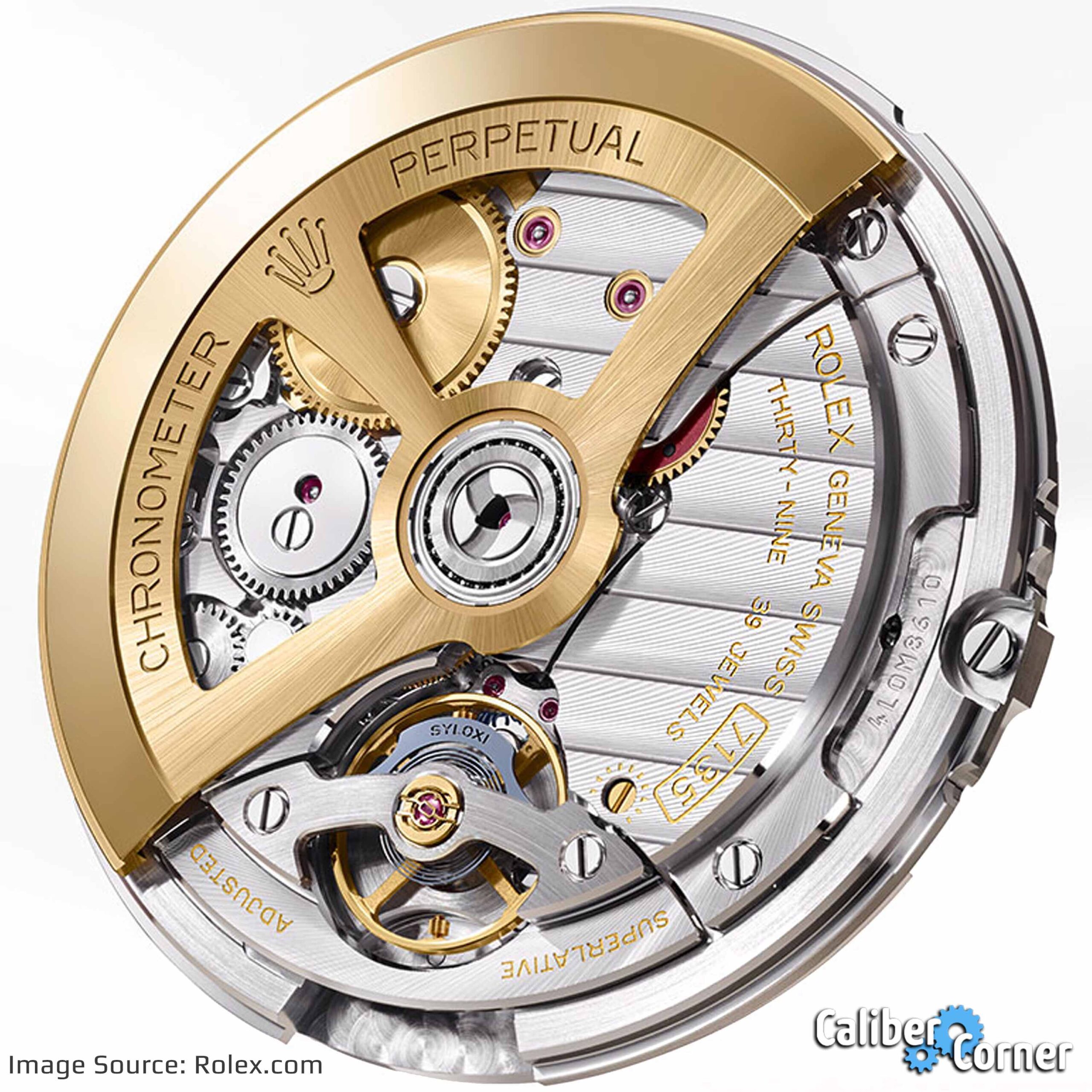
The Caliber 7135 — Rolex’s first completely new high-beat movement, featuring 32 patents. Image: CaliberCorner
The Dynapulse Escapement
At the heart of the 7135 is something Rolex calls the Dynapulse escapement — an indirect-impulse, double-wheel escapement made entirely of silicon, with a ceramic balance pivot. It’s the product of 32 separate patents (18 exclusive to this design), and it’s the reason Rolex can run at 5 Hz without burning through the power reserve. The movement still delivers a respectable 66-hour power reserve despite the higher frequency, thanks to the Dynapulse’s energy efficiency.
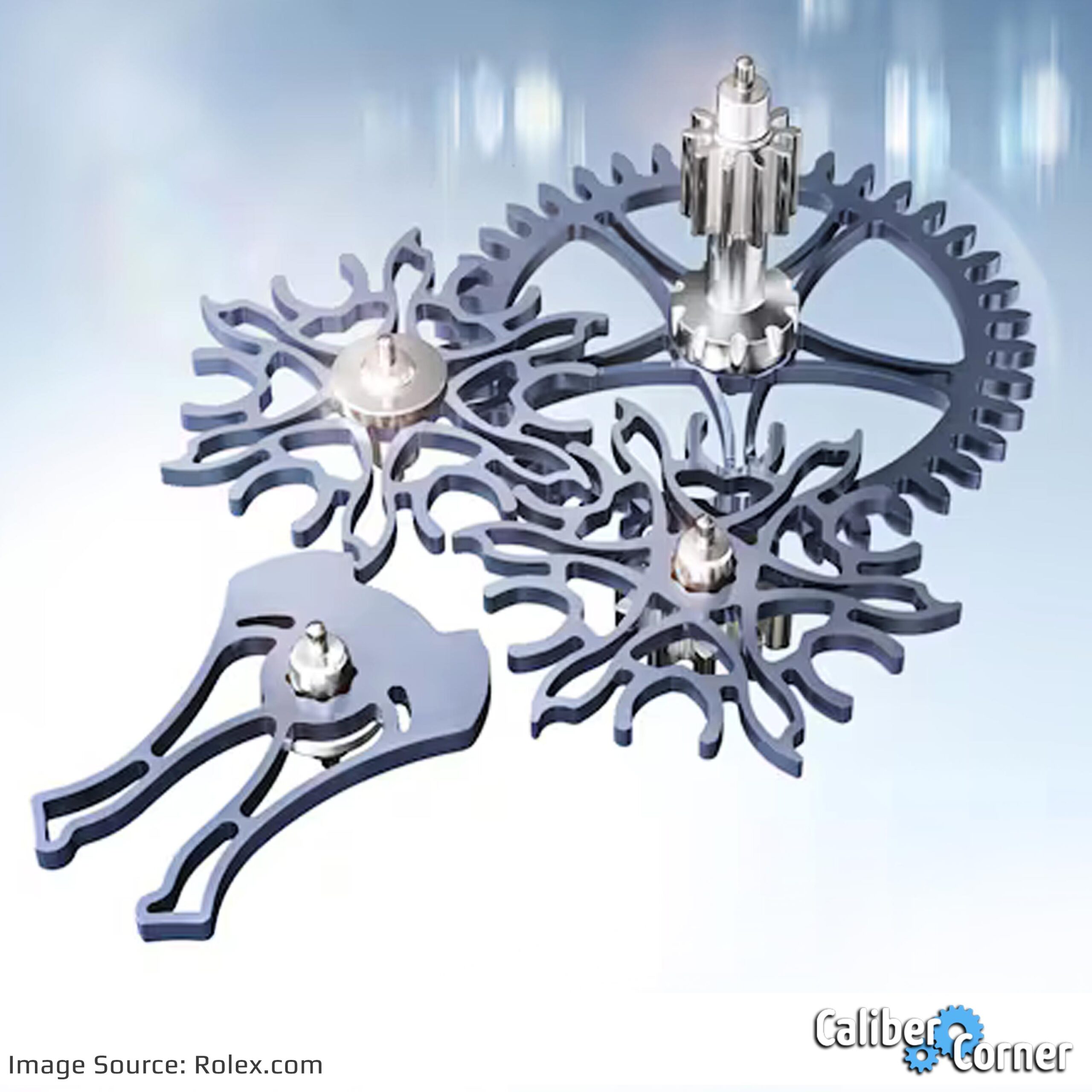
The silicon Dynapulse escapement — the component that makes 5 Hz viable in a production Rolex. Image: CaliberCorner
One early reviewer described the winding feel as “meditative” — fluid, quiet, deliberate. That’s not marketing copy. The Syloxi silicon hairspring (with a patented geometry featuring thicker coils for rigidity at high frequency), the optimized brass balance wheel (a first for Rolex), and the Paraflex shock absorbers all contribute to a movement that feels different from the moment you pick it up.
If you want to understand why the movements inside Rolex watches matter, the Caliber 7135 is exhibit A. This isn’t incremental refinement. It’s Rolex proving it can still engineer at the highest level in an era where most of its competitors have outsourced their innovation to silicon suppliers.
Here’s a detail that most coverage glosses over: the brass balance wheel. Rolex has used its proprietary Parachrom hairspring (a niobium-zirconium alloy) in nearly every movement for the past 15 years. But for the 7135, they switched to a Syloxi silicon hairspring paired with a brass balance wheel — the first time brass appears in a Rolex oscillator. Why? Because at 5 Hz, the Parachrom alloy vibrates at frequencies where its magnetic immunity becomes less of an advantage, and silicon’s geometric precision becomes more important. Rolex didn’t just design a new escapement. It rethought which materials make sense for a high-beat movement from scratch. That kind of first-principles engineering is rare in the Swiss watch industry, where most brands iterate on proven formulas.
Specs at a Glance
For the detail-oriented, here’s the full breakdown of the steel Land-Dweller Ref. 127334:
| Case Size | 40mm (also available in 36mm) |
| Case Thickness | 9.7mm |
| Material | Oystersteel with 18k white gold bezel |
| Movement | Caliber 7135, automatic, 5 Hz (36,000 bph) |
| Power Reserve | ~66 hours |
| Escapement | Dynapulse (silicon, double-wheel, indirect impulse) |
| Dial | Intense white, honeycomb motif, femtosecond laser engraved |
| Crystal | Sapphire with Cyclops lens |
| Water Resistance | 100 meters / 330 feet |
| Bracelet | Flat Jubilee (integrated), Crownclasp |
| Crown | Twinlock, screw-down |
| Case Back | Sapphire exhibition back |
| Certification | Superlative Chronometer (-2/+2 sec/day) |
| Retail Price | ~$14,900 |
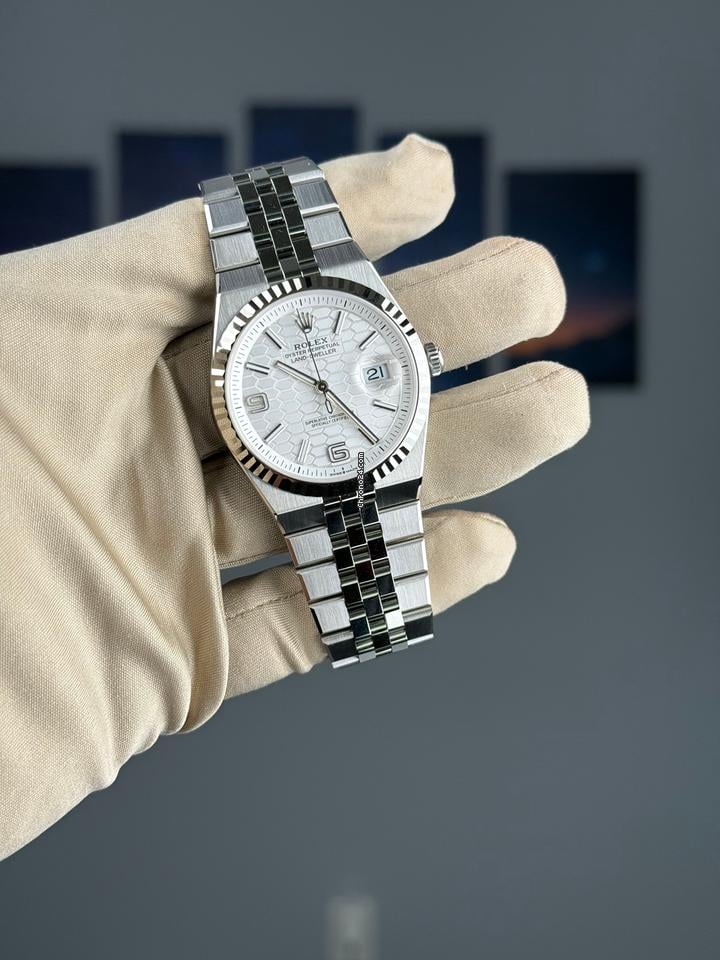
The full steel package — integrated bracelet, honeycomb dial, exhibition caseback. Image: Chrono24
On the Wrist: Wearability Verdict
Critics scored wearability between 8.5 and 9 out of 10, and after examining the dimensions, it’s easy to see why. At 9.7mm thick, the Land-Dweller is the slimmest Oyster Perpetual in the current lineup. That thin profile, combined with the integrated bracelet that tapers naturally, gives it a refined feel that most Rolex sport watches can’t match. It slides under a shirt cuff. It doesn’t catch on doorframes. It weighs enough to feel substantial without being a burden.
The 40mm case wears true to size — no phantom millimeters from a bulky bezel. And the 36mm variant opens the door for collectors who prefer smaller dimensions or who found the 40mm Datejust a touch too imposing. There’s a reason one reviewer called the comfort “hard to fault.”
One thing to note: the integrated bracelet means you’re locked into the Flat Jubilee. There’s no swapping to an Oyster or leather strap. For some collectors, that’s a dealbreaker. For others, it’s part of the watch’s identity. If you want to understand Rolex collections at a deeper level, this constraint is worth sitting with before pulling the trigger.
The Full Land-Dweller Lineup
Rolex launched the Land-Dweller across multiple references. Here’s the landscape:
- Ref. 127334 — Oystersteel & white gold, 40mm, intense white dial (~$14,900)
- Ref. 127335 — 18k Everose gold, 40mm, intense white dial (~$46,100)
- Ref. 127336 — 950 platinum, 40mm, ice blue dial (price on request, ~$64,800+)
- Ref. 127386TBR — Platinum with diamond-set bezel, 40mm, ice blue dial (~$116,900)
- 36mm variants — Available in corresponding materials for collectors preferring smaller proportions
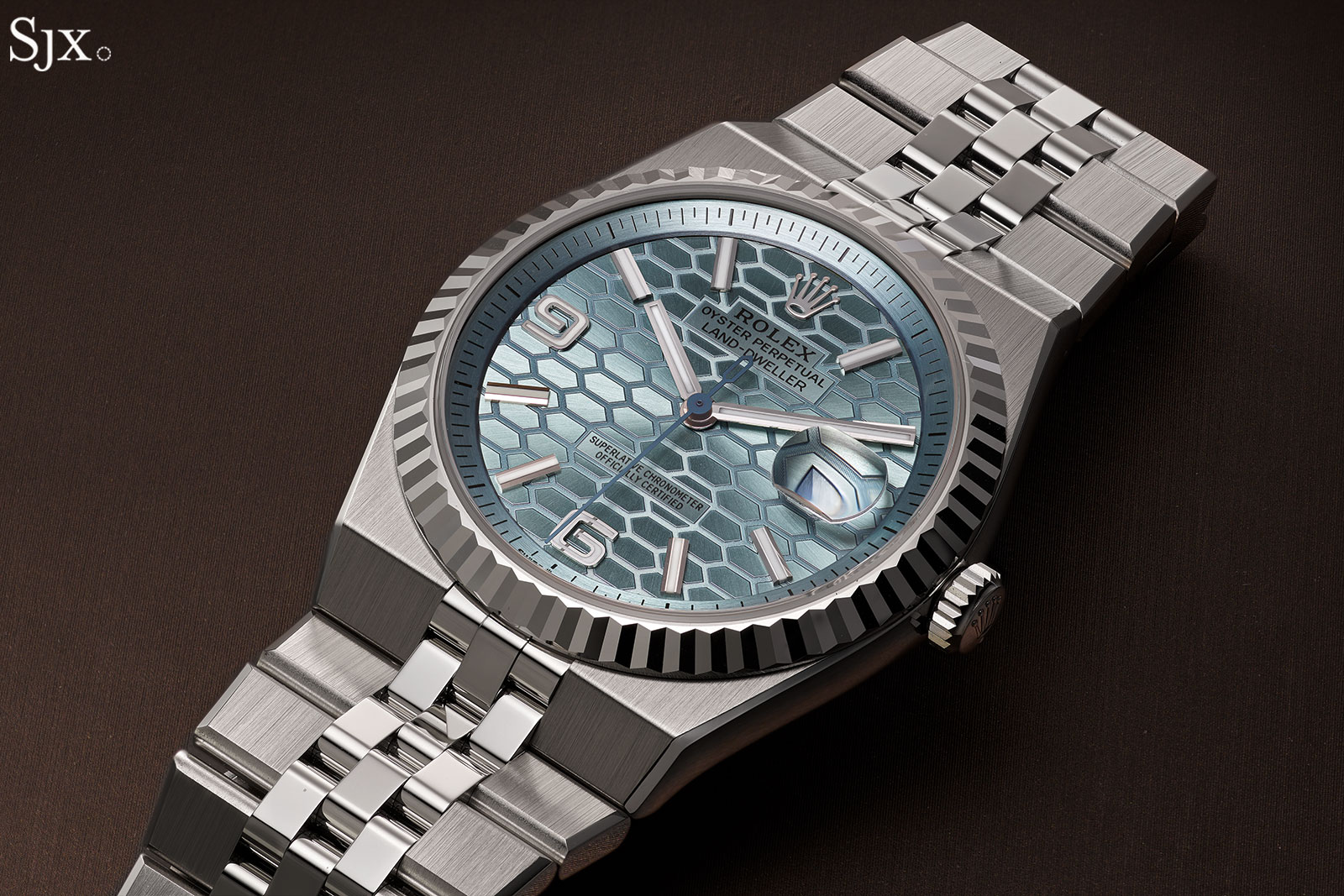
The platinum Land-Dweller with ice blue honeycomb dial — the premium expression of the collection. Image: SJX Watches
The steel model is the one dominating conversation, but the Everose gold version has been quietly gaining traction among collectors who find the steel too sporty and the platinum too ostentatious. The White Rolesor variant we’ve covered previously splits that difference nicely.
Value & Market Reality
At retail, the steel Land-Dweller is arguably the best value proposition in Rolex’s current lineup. You’re getting an entirely new movement architecture, an exhibition caseback (rare for Rolex), an integrated bracelet with genuine design ambition, and the brand’s most technically advanced escapement — all for roughly the same price as a steel Daytona.
The catch, of course, is availability. Like every desirable steel Rolex, you can’t simply walk into a boutique and buy one. The waitlist situation is intense, and the secondary market reflects that: prices have been reported above $85,000 in European markets for the steel 40mm. That’s a staggering premium over retail, though early adopter hysteria typically cools within 12 to 18 months as supply catches up.
For context on where the Land-Dweller sits in the broader Rolex luxury lineup, the Sky-Dweller starts around $15,000 in steel and the Day-Date in precious metals begins above $40,000. The Land-Dweller slots between them conceptually — dressier than a sports watch, more technical than a classic dress piece.
One thing working in the Land-Dweller’s favor for long-term value: it’s the first Rolex to use the Dynapulse escapement. That makes it historically significant in the same way the first Daytona with the in-house 4130 movement became a collector milestone. As Bob’s Watches noted in their 2025 release coverage, first-generation technical innovations from Rolex tend to appreciate, especially in steel.
The Contrarian Take: What Critics Got Wrong
Most reviews have been glowing, but here’s what gets lost in the enthusiasm. The Land-Dweller’s integrated bracelet design means Rolex is following a trend — AP Royal Oak, Patek Nautilus, every luxury brand is doing integrated bracelets right now. Rolex built its empire on the Oyster case, a design so versatile it could house a dive watch, a dress watch, and a racing chronograph under the same architectural language. Moving to an integrated design narrows that versatility. You can dress up a Datejust. You can dress down a Submariner. The Land-Dweller exists in a narrower stylistic band.
And then there’s the question of the exhibition caseback. Yes, collectors have been begging Rolex to show off its movements for years. But Rolex movements have historically been finished to functional standards, not decorative ones. The Caliber 7135 is spectacular engineering — but side by side with a Patek or even a JLC movement visible through a caseback, the finishing vocabulary is different. Rolex uses Côtes de Genève on the bridges and a 22k yellow gold rotor, but you won’t find hand-beveled edges or black-polished screws. That’s not a flaw; it’s Rolex being Rolex. But it’s worth knowing before you buy a watch partly for the view through the back.
Verdict
The Rolex Land-Dweller is the most interesting watch Rolex has released in at least a decade, and possibly longer. Not because it’s perfect — the integrated bracelet limits strap options, the design won’t appeal to everyone, and the grey market pricing is absurd right now. It’s interesting because it represents Rolex genuinely pushing boundaries on the movement side while simultaneously reinventing its approach to case design.
The Caliber 7135 with the Dynapulse escapement is the real headline. It’s a movement that validates Rolex’s position as a vertically integrated manufacture capable of developing escapement technology that most brands simply buy from suppliers. The honeycomb dial, the 9.7mm case, the exhibition back — those are supporting arguments.
If you can get one at retail, the steel Ref. 127334 is the buy. Period. The value proposition relative to what you’re getting technically is unmatched in the current Rolex catalog. If you can’t get one at retail, the 36mm variant may be easier to source and offers nearly the same experience in a more compact package.
This is Rolex in 2026 at its most ambitious. Whether it becomes a classic alongside the Submariner and Daytona or remains a polarizing niche reference depends entirely on how the next few years of production play out. But as a debut, the Land-Dweller has earned its place in the conversation.
Frequently Asked Questions
What movement does the Rolex Land-Dweller use?
The Land-Dweller uses Rolex’s Caliber 7135, a brand-new automatic movement running at 5 Hz (36,000 beats per hour). It features the revolutionary Dynapulse escapement made of silicon with a ceramic balance pivot, covered by 32 patents. Power reserve is approximately 66 hours.
How much does the Rolex Land-Dweller cost?
The steel Land-Dweller Ref. 127334 retails for approximately $14,900. The Everose gold version is around $46,100, and platinum models range from roughly $64,800 to $116,900 depending on gem settings. Secondary market prices for the steel model have been significantly higher due to demand.
Is the Land-Dweller water resistant?
Yes. The Land-Dweller has 100 meters (330 feet) of water resistance, thanks to Rolex’s Oyster architecture with a monobloc middle case, screw-down case back, and Twinlock winding crown. It’s suitable for swimming and everyday water exposure.
What sizes does the Land-Dweller come in?
The Land-Dweller is available in 40mm and 36mm case sizes. Both share the same Caliber 7135 movement and overall design language. The 36mm option is ideal for smaller wrists or collectors who prefer vintage-inspired proportions.
Can you change the bracelet on the Land-Dweller?
No. The Land-Dweller features an integrated Flat Jubilee bracelet that flows directly from the case. It cannot be swapped for other bracelet types or leather straps. The bracelet uses Rolex’s concealed Crownclasp for a clean, unbroken design.
What is the Dynapulse escapement?
The Dynapulse escapement is Rolex’s proprietary indirect-impulse, double-wheel escapement made entirely of silicon. It enables the Caliber 7135 to run at a high 5 Hz frequency while maintaining energy efficiency, resulting in a 66-hour power reserve. It represents 32 patents and is Rolex’s most significant escapement innovation to date.