

Reviews
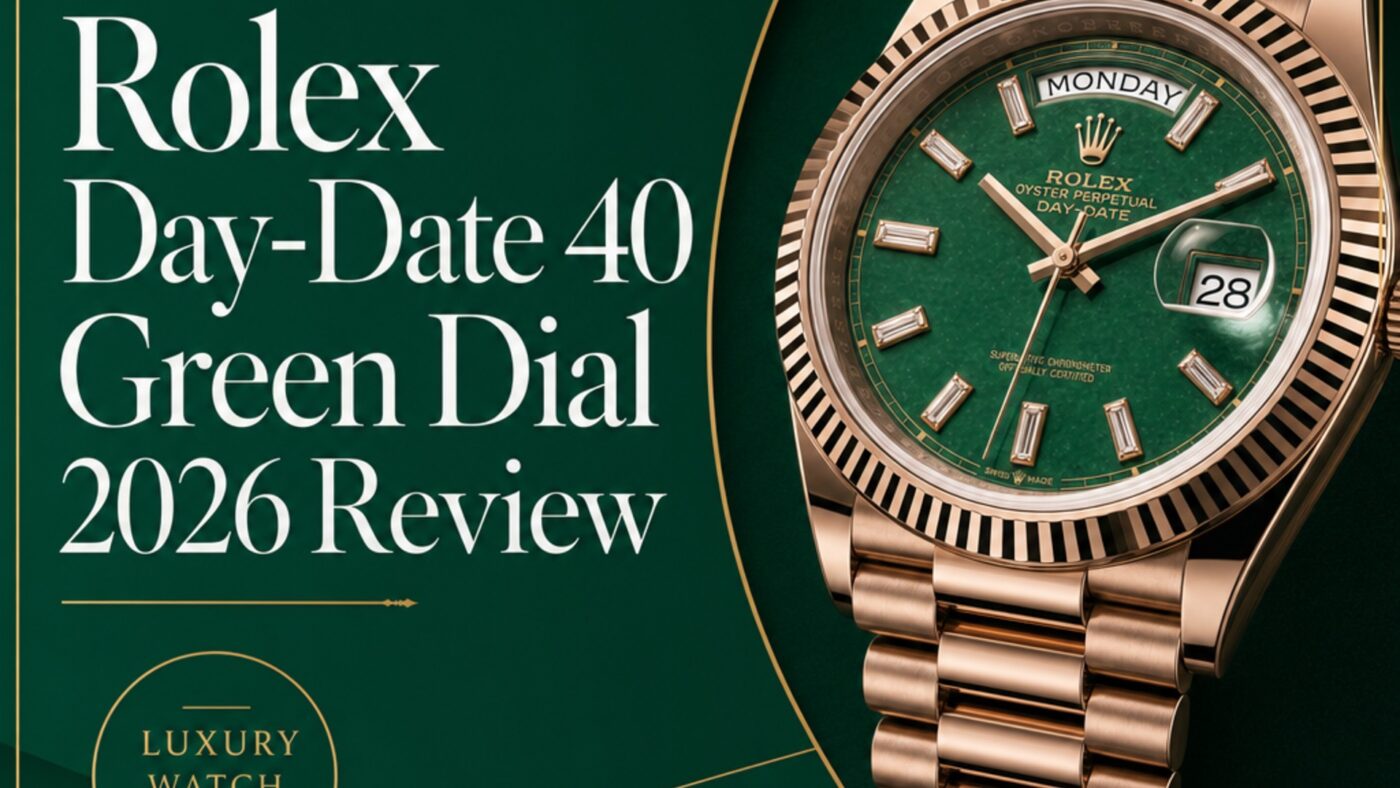
Rolex Day-Date 40 Green Dial 2026 Review: The President Goes Green
Apr
The Day-Date Gets Its Greenest Chapter Yet
Rolex has a complicated relationship with the color green. For decades, the brand treated it like a private reserve — a dial color rolled out sparingly, almost grudgingly, as if too much of it might dilute the mystique. The green Submariner “Hulk” proved that wrong. So did the green-dial Datejust 41 that followed. But the Day-Date? The President’s watch? That stayed safely in champagne, silver, and rhodium territory, with only the occasional olive or “presidential” green whispering through limited allocations.
Then 2026 happened. At Watches and Wonders in Geneva this April, Rolex unveiled not one but two distinct green-dial Day-Date 40s — and one of them arrives in a brand-new proprietary gold alloy the industry had never seen. This isn’t a cautious nod to trend. It’s a statement piece. The kind of watch that makes you wonder what took them so long.
Two Shades of Green, Two Very Different Watches
Before diving into the details, it helps to understand that these are not variations of the same theme. The 2026 Rolex Day-Date 40 green dial lineup consists of two watches separated by material, dial technique, and market positioning:
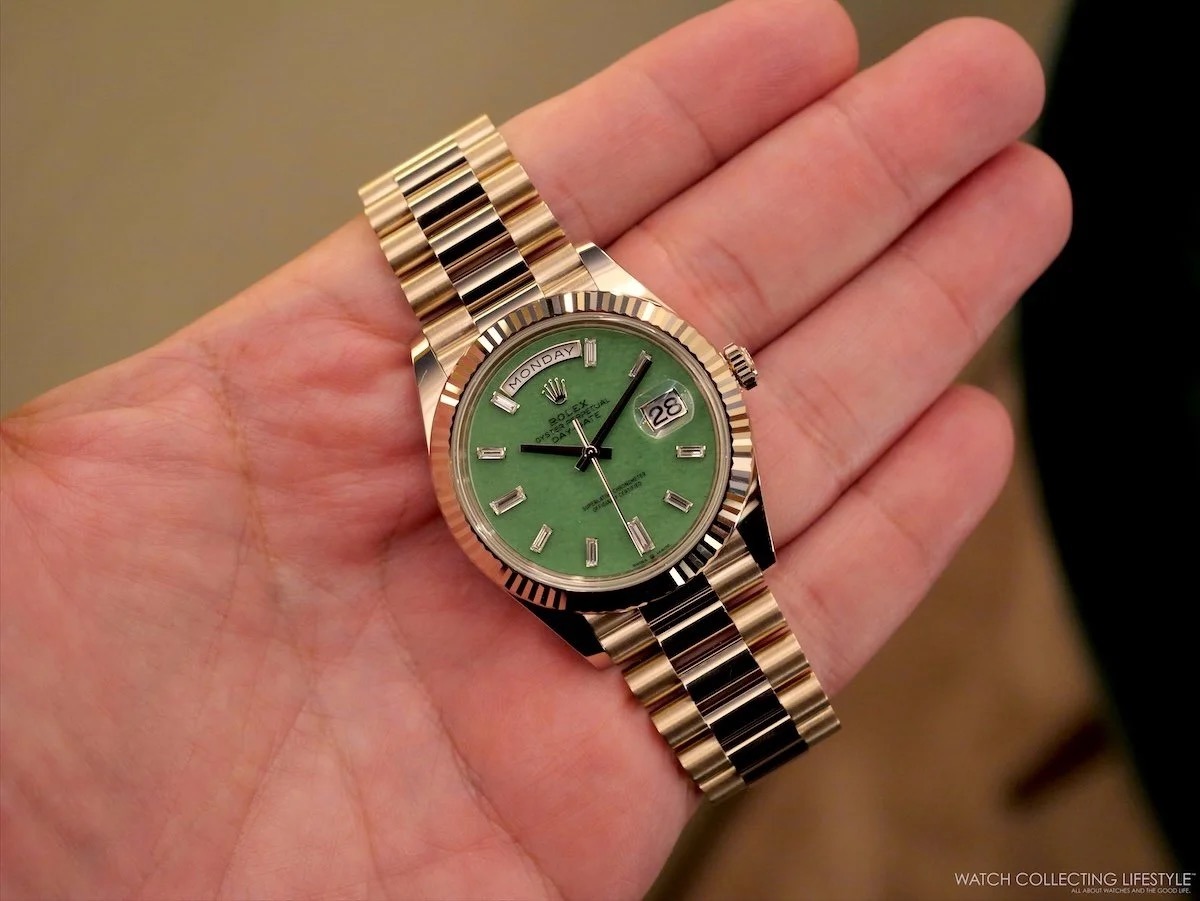
The Jubilee Green Aventurine (ref. m228235JG-0003) — an off-catalog, limited-allocation piece in Rolex’s new 18 ct Jubilee Gold with a natural aventurine stone dial that reads as a pale, luminous green. Ten baguette-cut diamond hour markers. The sort of watch that exists in a display case in Geneva, not on a dealer’s website.
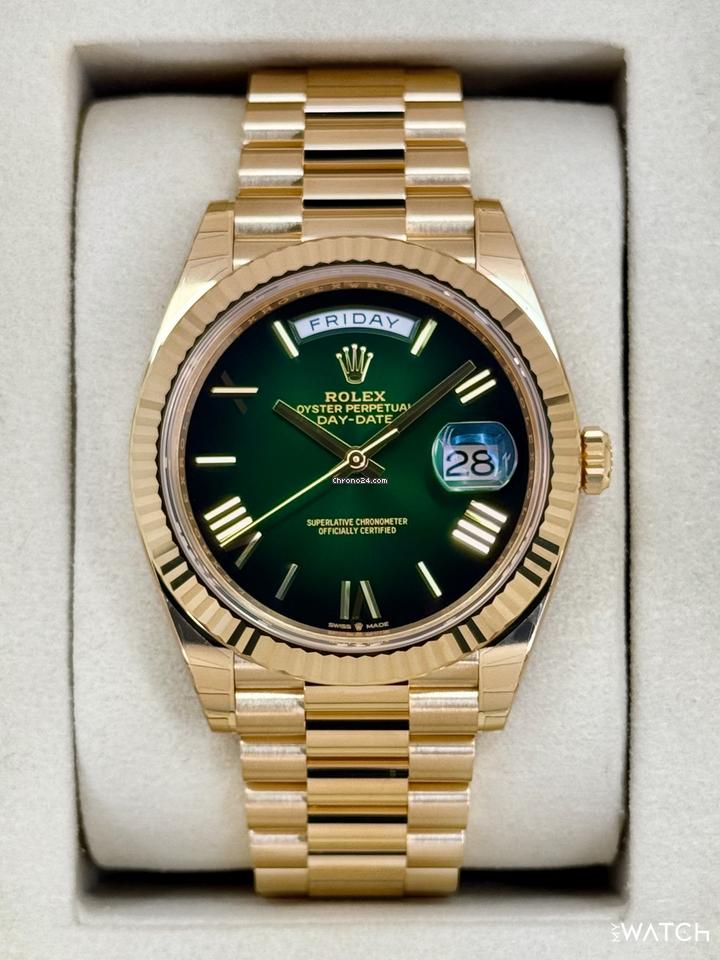
The Yellow Gold Green Ombré (ref. 228238-0061) — a catalog model in traditional 18 ct yellow gold with a lacquered “money green” dial that fades from deep forest at the edges to a brighter, warmer center. Roman numeral hour markers. Available through authorized dealers, at least in theory.
Both share the same 40mm Oyster case, the same Calibre 3255 movement, the same President bracelet. But wearing them feels entirely different. Let’s break down why.
Jubilee Gold and Green Aventurine: The Showstopper
The Jubilee Gold alloy is the real headline here. Rolex developed this 18 ct gold in-house specifically for select new 2026 releases, and it’s unlike anything in their existing material lineup. Depending on the light, it shifts between tender yellow, warm grey, and soft pink — a chameleon quality that standard yellow, white, or Everose gold simply can’t match. On the wrist, it reads warmer than white gold but cooler than yellow. There’s a restraint to it that feels modern without chasing trends.
The aventurine dial is what elevates this watch from “interesting new alloy” to “grail territory.” Aventurine is a natural quartz stone flecked with mineral inclusions that catch light like a starfield. On the Day-Date 40, it appears as a soft, grey-green canvas — not the saturated emerald you might expect from Rolex’s marketing imagery, but something more organic and subtly textured. The inclusions give the surface a granular shimmer that changes character under every lighting condition. Under direct sunlight, the green brightens and the stone’s crystalline structure becomes visible. Under office fluorescents, it settles into a muted, almost sage tone.
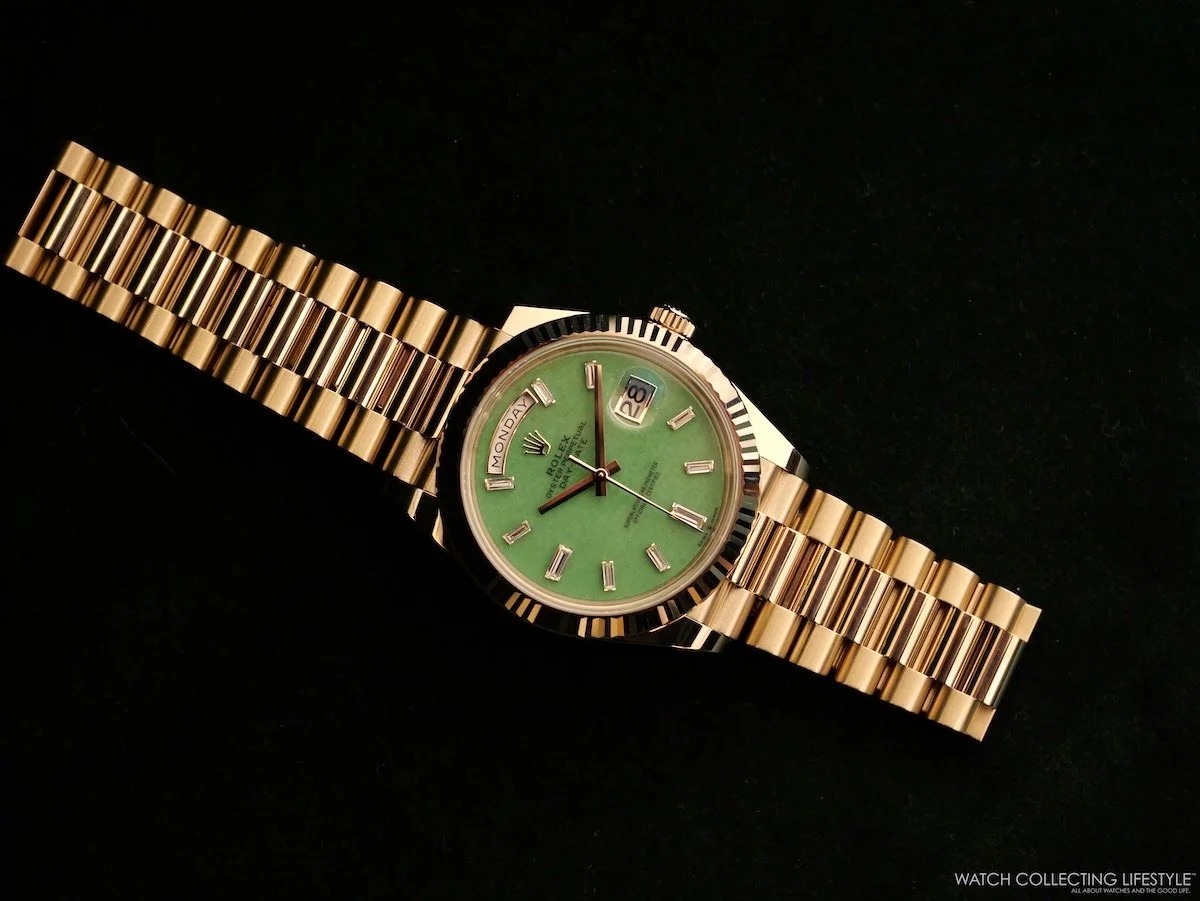
Ten baguette-cut diamond hour markers sit in raised gold settings against the aventurine. The effect is surprisingly restrained — Rolex could have gone the full high-jewelry route, but the elongated rectangular cuts feel architectural rather than ostentatious. The day window at 12 o’clock and date window at 3 o’clock (under the signature Cyclops magnifier) maintain the Day-Date’s functional identity. This is still a watch that tells you the day and date at a glance, not a piece of wrist jewelry that forgot it’s supposed to be a timepiece.
Because it’s off-catalog, Rolex doesn’t publish a retail price. Based on secondary market data from Chrono24 and dealer networks, expect to see asking prices well above the standard Day-Date 40 range if one even surfaces for sale. Most allocation pieces of this type go directly to VIP clients with established purchase histories.
Yellow Gold Green Ombré: The Accessible President
If the Jubilee Gold aventurine is the fantasy, the yellow gold green ombré is the reality most collectors will actually encounter. Reference 228238-0061 uses Rolex’s standard 18 ct yellow gold for both the 40mm Oyster case and the President bracelet — the same material combination that has defined the Day-Date since its introduction in 1956.
The dial is where this watch distinguishes itself. Rolex applies six layers of lacquer to build the “money green” gradient, starting with darker tones at the periphery and fading to a brighter, warmer center. It’s the same ombré technique the brand has used on select Datejust and Day-Date models, but the green execution here is notably richer than the 2019 green ombré Day-Date 36 that preceded it. The gradient creates genuine depth — the dial doesn’t read as flat paint but as something with dimensionality. Roman numeral hour markers in applied gold give it a classical, formal character that contrasts nicely with the non-traditional color.
Secondary market pricing for unworn examples sits around $69,500 as of April 2026, though this figure fluctuates based on condition, box and papers inclusion, and regional demand. Retail pricing through authorized dealers follows Rolex’s standard structure, but expect the familiar allocation dance — this is not a watch you walk in and purchase on your first visit.
The Calibre 3255: What’s Inside the Case
Both green dial variants are powered by the Calibre 3255, Rolex’s flagship automatic movement for the Day-Date line. Introduced in 2015 alongside the Day-Date 40 itself, the 3255 represented a generational leap over the outgoing Calibre 3156, picking up 14 patents in the process.
The headline spec is the 70-hour power reserve — a full day longer than the 3156’s 48 hours. Rolex achieved this through a redesigned barrel architecture with walls 50% thinner than the previous generation, allowing a longer mainspring to fit in the same space. The Chronergy escapement contributes another 15% efficiency gain over a standard Swiss lever escapement, thanks to its offset design, lighter components, and doubled contact surfaces. The escapement is manufactured from nickel-phosphorus, making it resistant to magnetic interference — a practical benefit in a world where magnetic fields from laptops, tablets, and phone speakers are omnipresent.
The blue Parachrom hairspring handles the other major environmental variable: temperature. This paramagnetic alloy resists both magnetic fields and thermal variation, and the Rolex overcoil ensures positional stability across the movement’s various orientations. The beat rate is 28,800 vibrations per hour, and the movement carries Rolex’s Superlative Chronometer certification — tested to -2/+2 seconds per day after casing, which is twice as precise as the standard COSC chronometer specification.
For 2026, Rolex has reportedly upgraded the certification process further, though the brand characteristically doesn’t publish specifics. What’s visible on the wrist is the same: set the watch on Friday evening, pick it up Monday morning, and it’s still running with seconds to spare. The instant day and date changes at midnight remain satisfyingly crisp.
The President Bracelet: Seven Decades of Continuity
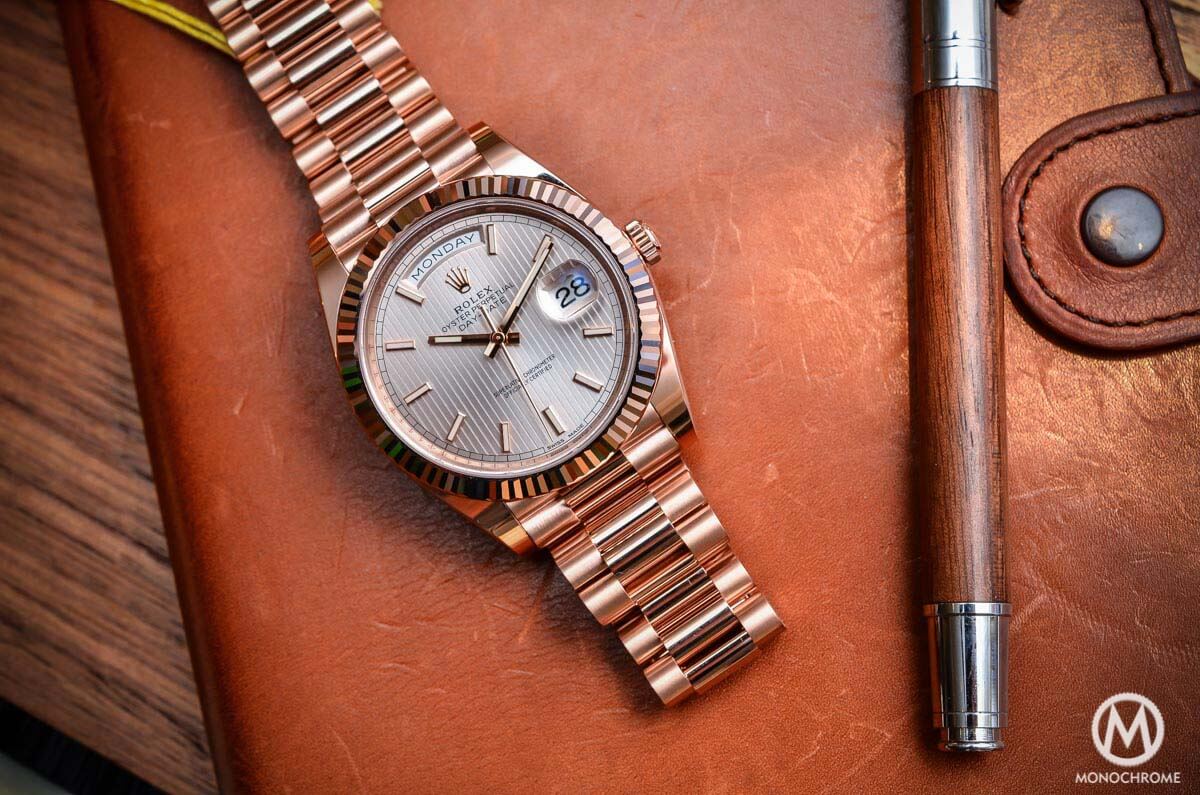
The bracelet is inseparable from the Day-Date’s identity. Rolex introduced the semi-circular three-piece link design in 1956 alongside the original Day-Date reference 6611, and the formula has remained remarkably consistent for nearly 70 years. The modern President bracelet on the Day-Date 40 features solid links with polished center sections and satin-finished outer links, ceramic inserts between the links for wear resistance, and the concealed folding Crownclasp that maintains the bracelet’s clean visual line.
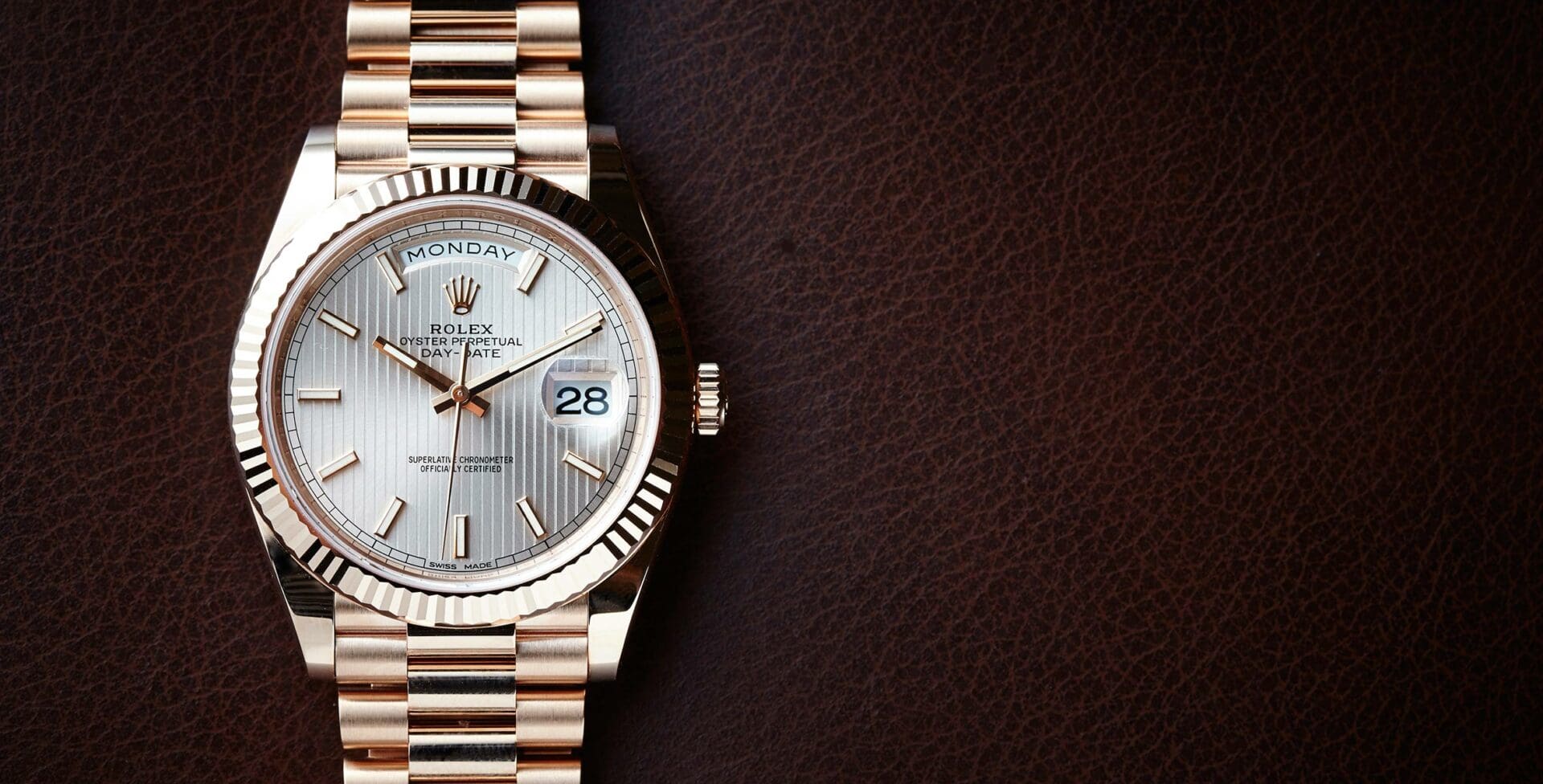
What most buyers overlook when evaluating the President bracelet is how it ages. The satin-finished outer links develop a soft patina over years of wear that actually enhances the visual contrast against the polished center. On the Jubilee Gold variant, this aging process will be particularly interesting to watch — the alloy’s color-shifting properties mean the bracelet will evolve in ways standard yellow gold simply doesn’t. Ceramic inserts between the links prevent the stretching that plagued older gold bracelets, so the fit should remain tight for the long haul.
The Day-Date earned its “President” nickname because of its association with world leaders — Eisenhower, Kennedy, Johnson all wore one. But the bracelet itself contributed to the mystique. It’s the only Rolex bracelet that has never been offered on a non-Day-Date model. You cannot buy a President bracelet on a Submariner, a GMT-Master, or a Datejust. It belongs exclusively to the Day-Date, which makes it the most clearly signified bracelet in the entire Rolex catalog.
Why Rolex Keeps Returning to Green
There’s a backstory here that most coverage misses. Green has been Rolex’s corporate color since the early 20th century — the brand’s trademark crown logo has always been rendered in green, and the iconic green Rolex box predates most of the watches that go inside it. But translating a corporate brand color into a dial color took decades. The first green-dial Rolex that genuinely resonated with collectors was the 2003 Submariner 16610LV, the original “Kermit,” released for the Submariner’s 50th anniversary. That watch was widely panned at launch. Too bold. Too unconventional. A green Submariner? Absurd.
Fast forward to 2026, and the Kermit trades at roughly double the price of an equivalent black-dial 16610. The market eventually caught up to what Rolex understood from the start: green on a dial is a power move. It signals that a watch doesn’t need to be conservative to be classic.
The Day-Date’s adoption of green follows this pattern but adds another layer. The Day-Date has always been Rolex’s most formal, most conservative model — the watch you wear to a board meeting, not a beach bar. Putting a green dial on a Day-Date is more transgressive than putting one on a Submariner, which is already a sport watch. It’s a calculated provocation. And doing it twice — once in stone, once in lacquer — shows Rolex isn’t hedging.
Specs at a Glance
| Specification | Jubilee Gold Aventurine (m228235JG-0003) | Yellow Gold Ombré (228238-0061) |
|---|---|---|
| Case Material | 18 ct Jubilee Gold (proprietary alloy) | 18 ct yellow gold |
| Case Diameter | 40mm | 40mm |
| Thickness | ~12mm | ~12mm |
| Bezel | Fluted | Fluted |
| Dial | Natural green aventurine stone | Lacquered green ombré (6 layers) |
| Hour Markers | 10 baguette-cut diamonds | Applied gold Roman numerals |
| Movement | Calibre 3255, automatic | Calibre 3255, automatic |
| Power Reserve | 70 hours | 70 hours |
| Water Resistance | 100 meters | 100 meters |
| Bracelet | President with Crownclasp | President with Crownclasp |
| Crystal | Sapphire with Cyclops | Sapphire with Cyclops |
| Pricing | Off-catalog / limited allocation | ~$69,500 secondary market |
Pricing and Availability: What to Actually Expect
Neither of these watches is what you’d call accessible. The yellow gold ombré is technically a catalog model, which means it should be available through any authorized Rolex dealer. In practice, the Day-Date 40 has always been tightly allocated, and a green dial variant will only tighten that squeeze. Expect a wait, a purchase history, and probably a polite suggestion to consider other models first.
The Jubilee Gold aventurine is a different beast entirely. Off-catalog means it doesn’t appear on Rolex’s public website or in standard dealer inventories. These pieces are allocated directly to top-tier clients through select authorized dealers, typically in major markets like Geneva, London, New York, Hong Kong, and Dubai. If you’re not already on a dealer’s VIP list, your chances of obtaining one at retail are effectively zero.
Secondary market pricing for the Jubilee Gold variant is speculative at this point. Comparable off-catalog stone-dial Day-Dates from previous years have commanded premiums of 40-60% above equivalent catalog models. With the added novelty of the Jubilee Gold alloy, expect that premium to hold or increase in the short term.
Who This Watch Is Really For
Here’s the contrarian take: the 2026 green Day-Date 40 is not for the seasoned Day-Date collector who already has a champagne dial, a rhodium dial, and a blue dial in the watch box. Those collectors will buy it anyway, because that’s what collectors do. The green Day-Date is for the buyer who was never interested in the Day-Date before — the one who dismissed it as their grandfather’s watch, or a banker’s cliché, or simply too safe.
Green changes the equation. It makes the Day-Date look modern without redesigning it. It adds visual energy to a case shape that has been unchanged since 2015 (and barely changed since 1956). And it does this without sacrificing any of the gravitas that makes the Day-Date the Day-Date. You can still wear it to a board meeting. You can still wear it to a state dinner. But now you can also wear it somewhere a traditional champagne dial would feel stuffy, and it works.
Frequently Asked Questions
What is the difference between the two 2026 Rolex Day-Date 40 green dial models?
The Jubilee Gold Green Aventurine (ref. m228235JG-0003) features a natural stone dial with a light, shimmering green tone in Rolex’s new proprietary 18 ct Jubilee Gold alloy, with baguette diamond markers. The Yellow Gold Green Ombré (ref. 228238-0061) uses traditional 18 ct yellow gold with a six-layer lacquered gradient dial that fades from dark green edges to a brighter center, with Roman numeral markers.
How much does the 2026 Rolex Day-Date 40 green dial cost?
The yellow gold ombré variant trades at approximately $69,500 on the secondary market for unworn examples. The Jubilee Gold aventurine is an off-catalog piece with no published retail price, and secondary market values are expected to exceed standard Day-Date 40 pricing by a significant margin.
What movement does the Rolex Day-Date 40 use?
Both 2026 green dial models use the Calibre 3255, Rolex’s in-house automatic movement with a 70-hour power reserve, Chronergy escapement, blue Parachrom hairspring, and Superlative Chronometer certification rated at -2/+2 seconds per day.
Is the green aventurine dial natural stone?
Yes. The Jubilee Gold variant uses a natural aventurine stone dial — a type of quartz with mineral inclusions that create a subtle shimmer effect. Each dial is unique because the stone’s natural pattern varies from piece to piece.
Will the 2026 green Day-Date 40 hold its value?
Based on historical performance of limited and off-catalog Day-Date variants, both models are likely to hold or appreciate above retail. Green-dial Rolexes have consistently outperformed equivalent non-green variants on the secondary market since the original Kermit Submariner in 2003.
The Verdict
The 2026 Rolex Day-Date 40 green dial isn’t just a new colorway. It’s Rolex demonstrating, yet again, that it can make the oldest trick in the book feel fresh — take a heritage model, apply a single bold choice, and let the design do the talking. The Jubilee Gold aventurine is the collector’s piece, the one that will appear in auction catalogs a decade from now with provenance notes and escalating estimates. The yellow gold ombré is the one you’d actually wear every day, if you’re fortunate enough to secure one.
For more on the broader evolution of Rolex watch designs, or to understand how Rolex reference numbers work and what m228235JG-0003 actually means, explore our other guides.