

Articles
The 8 Cheapest Rolex Watches You Can Buy (2026 Updated)
Feb
Let’s be honest about something right up front: “cheap” and “Rolex” don’t really belong in the same sentence. Even the most affordable models from the Crown now start above $6,000 at retail, and that number has climbed steadily every year since 2020. But if you’re set on joining the club, there are still genuine entry points that won’t require a second mortgage. This updated guide covers the eight cheapest Rolex watches you can actually buy in 2026, with current retail prices, what makes each model tick, and the real story behind recent price hikes that have reshaped the entry-level landscape.
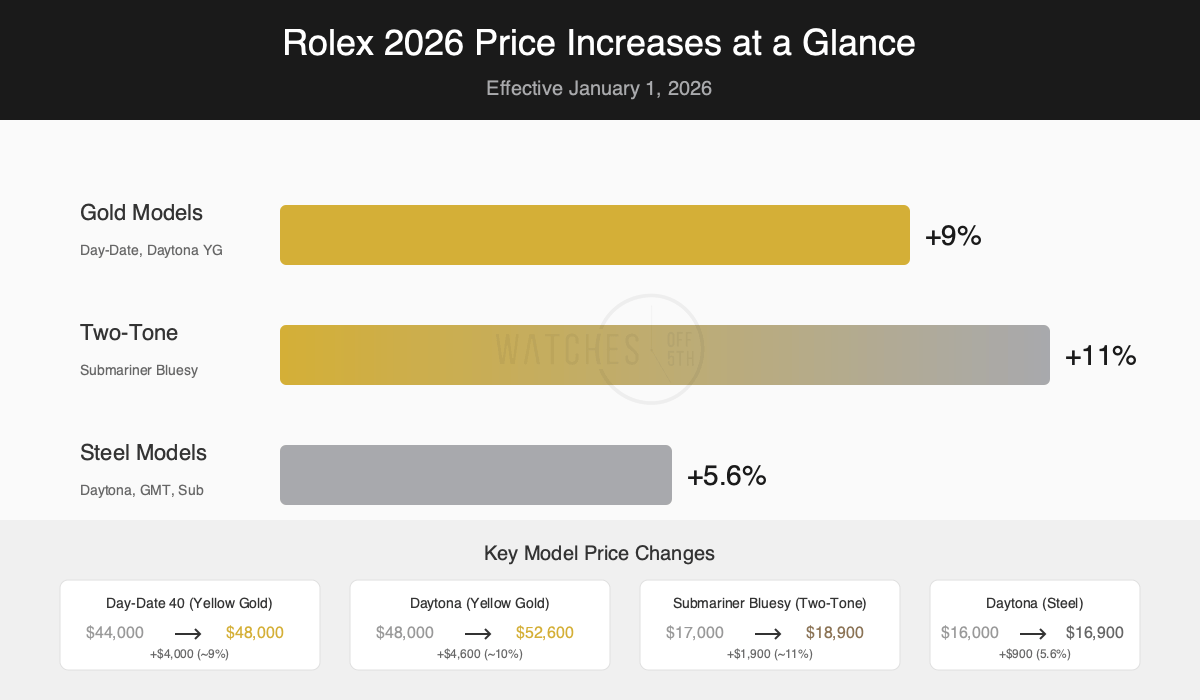
Before we get into the list, there’s something you should know. Rolex raised prices again in early 2026, continuing a streak of annual increases that has pushed steel sport models up roughly 15-20% since 2022. According to Monochrome Watches’ year-over-year tracking, the 2026 bump landed between 2% and 6% depending on the reference and metal. Steel models saw the smaller end of that range, while gold and two-tone pieces absorbed the heavier hits. What that means for you: the Oyster Perpetual that cost $5,150 in 2022 now retails closer to $6,500.
Here’s what most buyers overlook when hunting for the cheapest Rolex: the retail price is only half the equation. Many of these models trade well above MSRP on the secondary market, while a handful actually sell below retail if you’re willing to shop pre-owned. We’ll flag those opportunities as we go through each model.
1. Rolex Oyster Perpetual — Starting at ~$6,000
The Oyster Perpetual remains the undisputed champion of affordability in the Rolex lineup. It’s the purest expression of what Rolex does: a time-only watch with a bulletproof movement, housed in an Oystersteel case, finished to a standard that makes watches twice its price look sloppy by comparison.
For 2026, the Oyster Perpetual is available in five case sizes: 28mm, 31mm, 34mm, 36mm, and 41mm. The entry point is the 28mm reference 276200, which retails around $6,000. Step up to the 36mm or 41mm — the sizes most men gravitate toward — and you’re looking at roughly $6,500. That price includes the Calibre 2232 (28-34mm) or Calibre 3230 (36-41mm), both of which deliver a 70-hour power reserve and Superlative Chronometer certification.
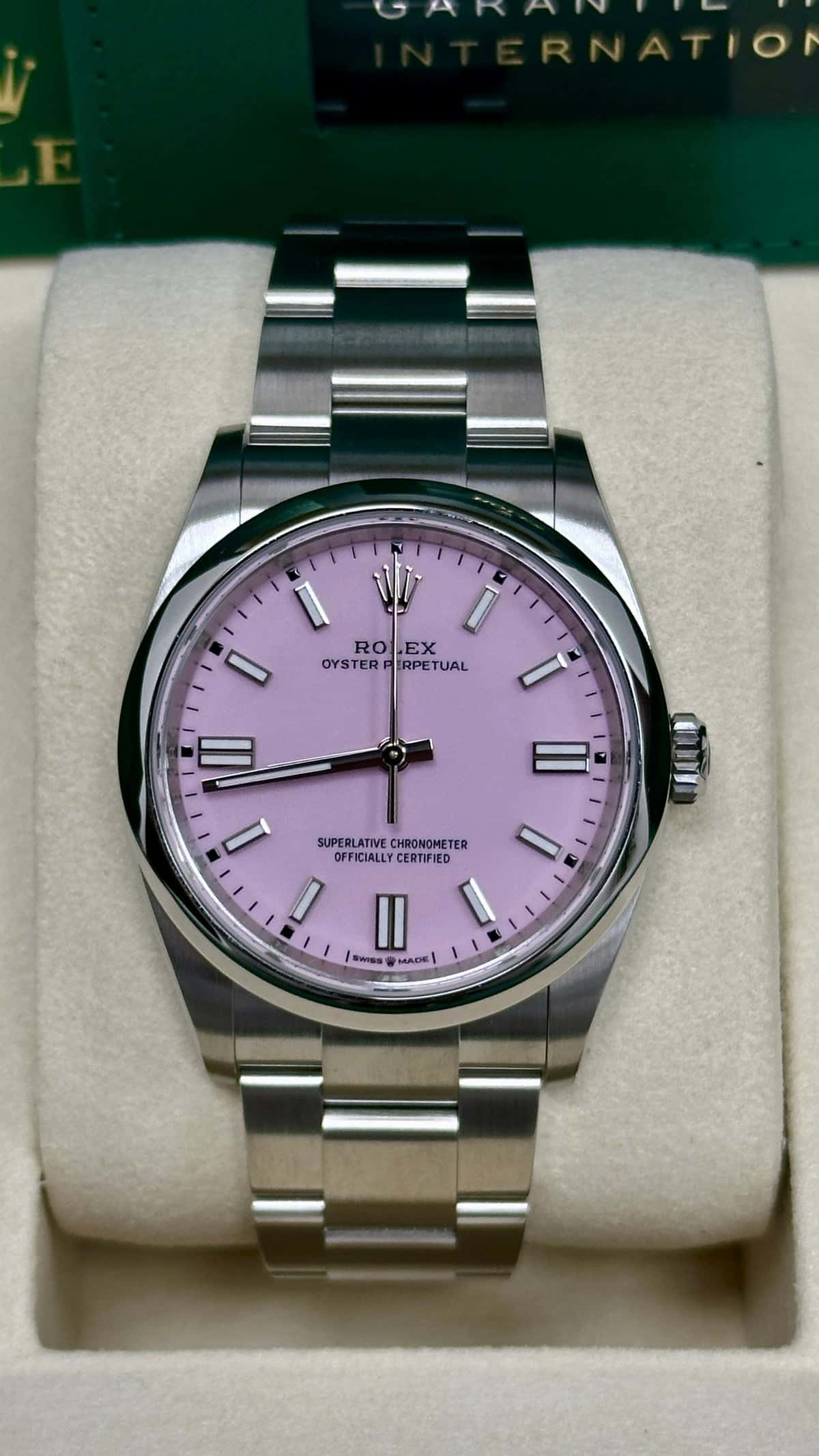
2026 also brought something unexpected to the OP lineup: a slate of new “candy” dial colors, including a pink pastel and a beige tone that have sent collectors scrambling. The candy pink 41mm (reference 134300) has already been spotted on the secondary market for $11,000 to $15,000, according to Chrono24 listings. That’s more than double retail for what is, mechanically speaking, the simplest watch Rolex makes. The lesson? Dial color matters more than complications when it comes to resale value.
What you get for the money is genuinely impressive. The 904L Oystersteel case is machined from a solid block, the sapphire crystal is virtually scratch-proof, and the Twinlock crown seals the case to 100 meters of water resistance. There’s no date complication, no rotating bezel, no chronograph. Just time, executed flawlessly. Some collectors consider this the most honest watch Rolex makes.
2. Rolex Explorer 36 — ~$7,900
The Explorer is one of the most historically significant watches in the Rolex catalog. It was born from a real-world test that most watches would never survive: Sir Edmund Hillary and Tenzing Norgay wore Rolex Oyster Perpetuals during their summit of Mount Everest in 1953. That expedition forged a legend, and the Explorer has carried that DNA ever since.
The current-generation Explorer 36 (reference 124270) sits at roughly $7,900 at retail, making it one of the best values in steel sport watches. Under the hood, you’ll find the Calibre 3230, the same movement used in the larger Oyster Perpetual models, with a 70-hour power reserve and the full complement of Rolex engineering: Paraflex shock absorbers, a blue Parachrom hairspring, and the brand’s signature Chronergy escapement for better efficiency.
Here’s something that makes the Explorer 36 genuinely unusual among steel Rolex sport models: it trades at or slightly below retail on the secondary market. Most steel sports Rolexes carry a premium over MSRP, sometimes a huge one. The Explorer 36 doesn’t. If you’re willing to buy pre-owned, you can often pick one up for $7,500 or less, which is a remarkable deal for what you’re getting.
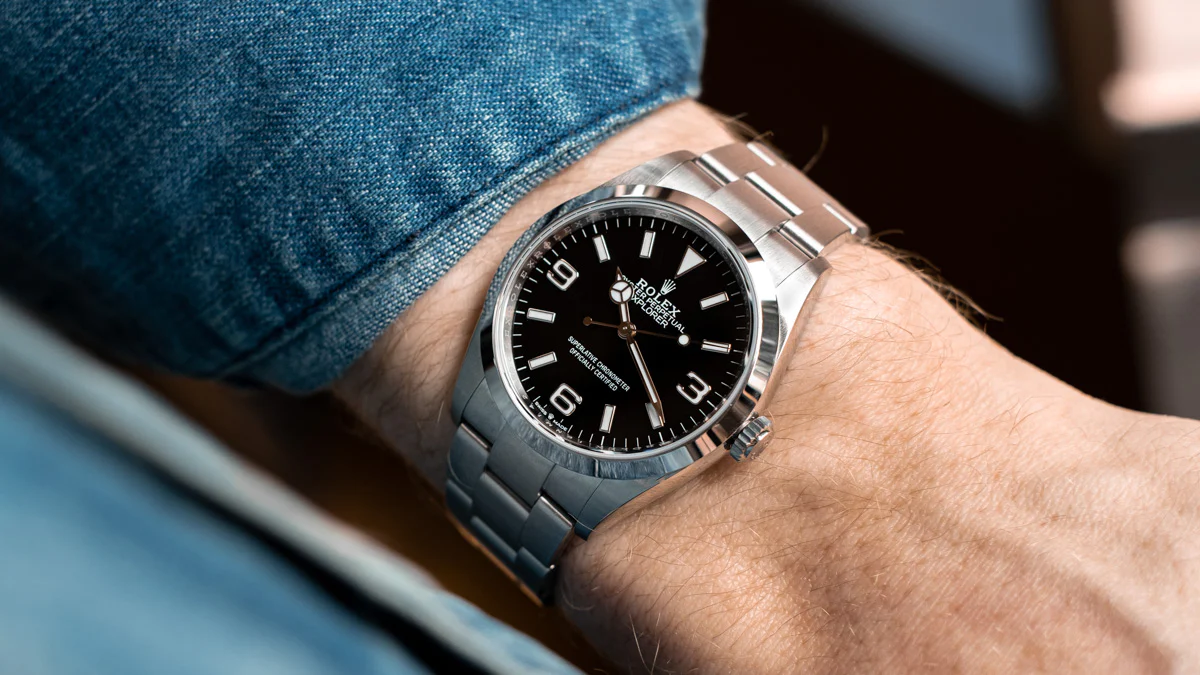
The design is understated almost to a fault. Black dial, Arabic numerals at 3, 6, and 9, Mercedes hands, and a smooth bezel. It’s the anti-Submariner — no rotating bezel, no date magnifier, no flash. Just a clean three-hand watch with pedigree that traces back to the summit of the world’s tallest mountain. We carry a range of Explorer models in our catalog if you want to explore the full lineup.
3. Rolex Explorer 40 — ~$8,350
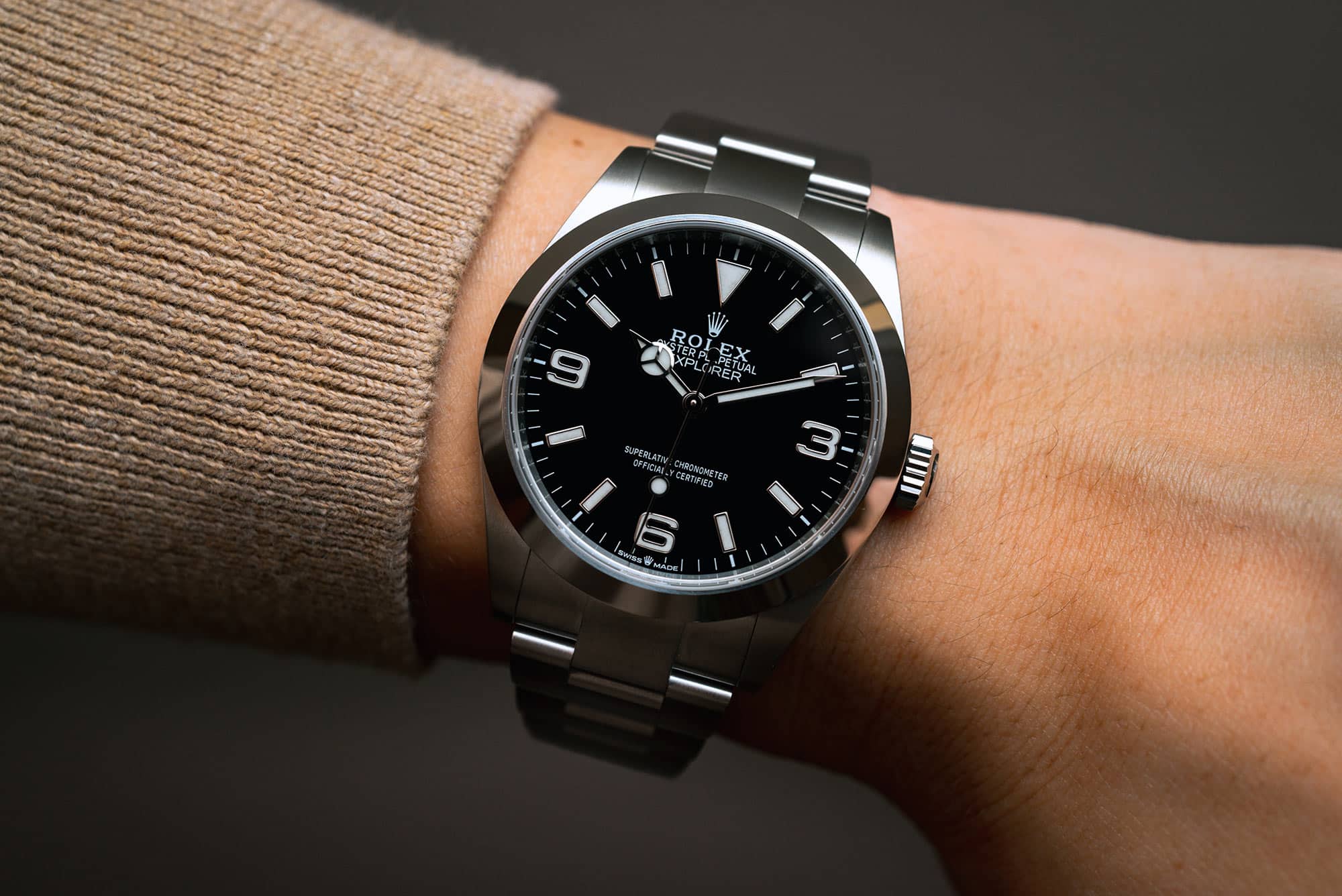
In 2025, Rolex expanded the Explorer range with a 40mm version (reference 224270), addressing years of collector requests for something between the 36mm and the now-discontinued 39mm. The 40mm has quickly become the sweet spot for buyers who found the 36 too small and the old 39 a bit of a compromise in proportions.
At roughly $8,350, the Explorer 40 costs about $450 more than its smaller sibling. Same Calibre 3230 movement, same 100-meter water resistance, same Oystersteel construction. The premium is purely about size. And in 2026, that size premium is worth paying if you have wrists over 7 inches, because the 40mm wears with a confidence the 36 can’t quite match on larger arms.
One detail worth flagging: the Explorer 40 features the Chromalight display with long-lasting blue luminescence. In dim conditions, those applied hour markers glow an intense, even blue that stays visible for up to eight hours. It’s a small thing on paper, but in practice, it’s one of those quality touches that separates Rolex from almost everything else at this price point.
4. Rolex Air-King — ~$9,000
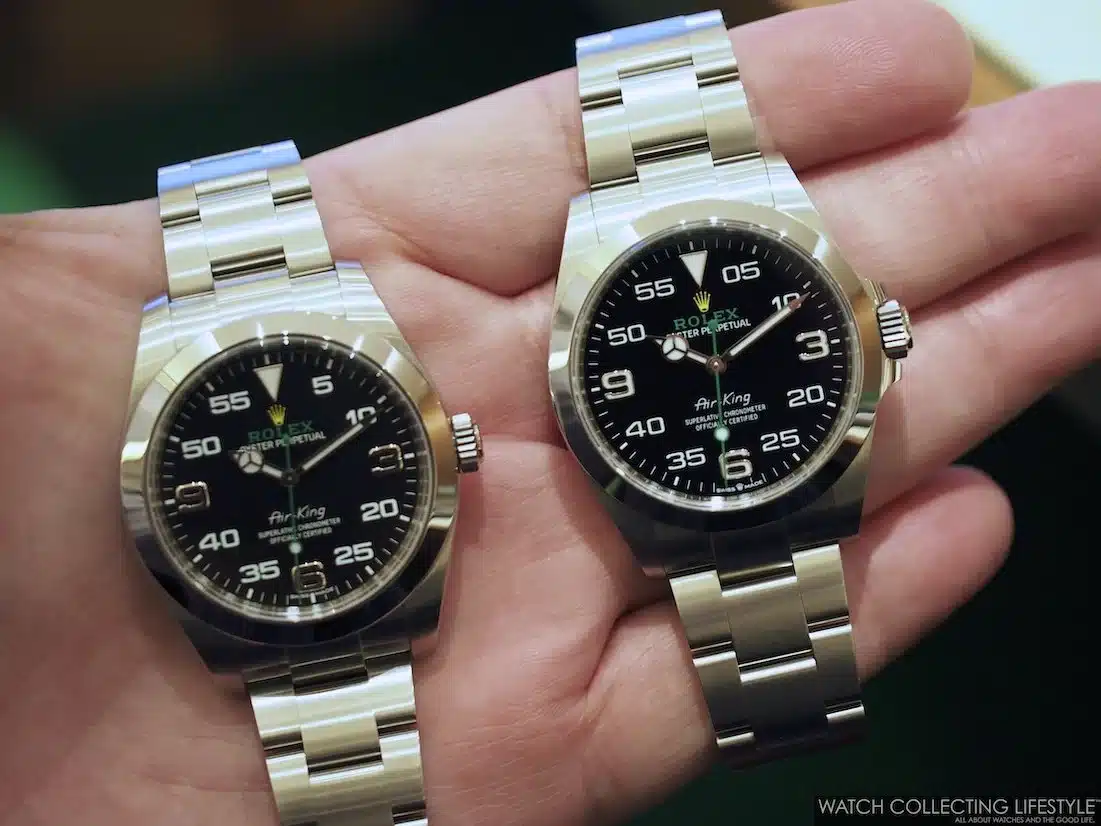
The Air-King has had a turbulent existence in the Rolex catalog. Introduced in the 1940s to honor RAF pilots, it was discontinued, brought back in 2016 with a divisive design, then refreshed again in 2022 with the reference 126900 that fixed nearly every complaint about the previous generation. The current version is the best Air-King Rolex has made in decades, and at approximately $9,000 retail, it fills a meaningful gap between the Explorer and the Datejust.
What makes the 126900 special is its peculiar dial. The hour markers are a mix of applied Arabic numerals (5-minute intervals) and triangular, rectangular, and round indices at the cardinal positions. It’s unconventional and polarizing, but there’s a historical logic to it: the original Air-King dashboard clocks used a similar mixed-marker layout for quick readability during flight. The 3, 6, and 9 numerals glow green, while the other markers glow blue, creating a two-tone Chromalight display unlike anything else in the lineup.
Under the dial sits the Calibre 3230 — the same movement used in the Explorer and Oyster Perpetual 41. The Air-King also gets the Oyster bracelet with the Easylink comfort extension, which adds about 5mm of length with a simple fold-out mechanism. It’s one of those features you don’t think about until you need it on a hot day when your wrists swell.
Our Air-King collection includes both the current reference and older models if you’re looking for something a bit different. The Air-King 34mm (reference 114234) is another option at a lower price point for those who prefer a more traditional size. Check out our Air-King 114234 listing for details.
5. Rolex Datejust 36 — ~$9,000
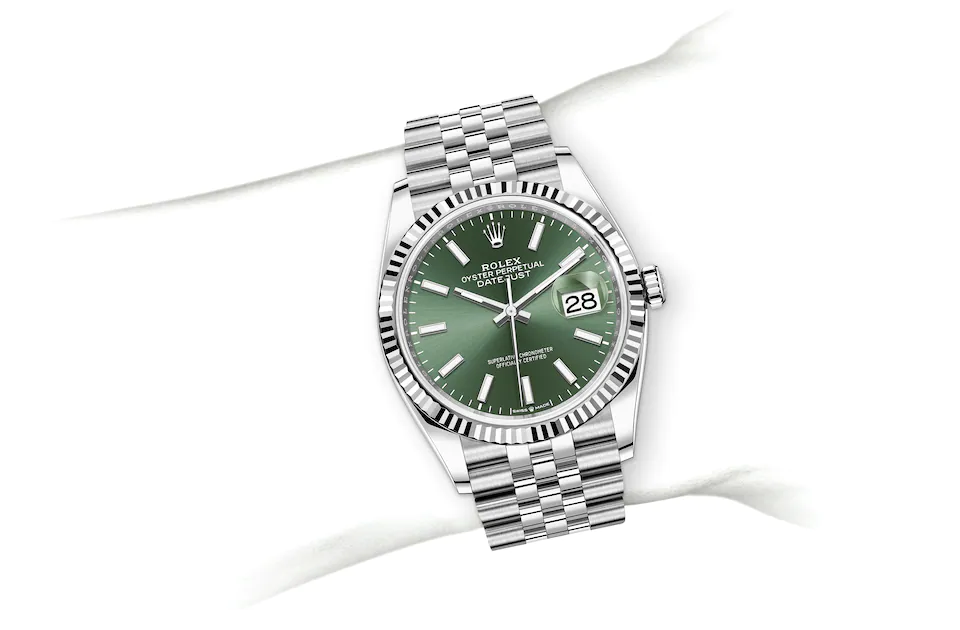
The Datejust might be the most important watch Rolex ever made. Introduced in 1945 to celebrate the brand’s 40th anniversary, it was the first self-winding wristwatch to display the date in a window at 3 o’clock. That sounds mundane now, but in 1945 it was revolutionary. The Cyclops magnifying lens, added in the early 1950s, made the date readable at a glance and became one of the most recognizable design elements in watchmaking history.
The current Datejust 36 in Oystersteel with a smooth bezel (reference 126200) retails around $9,000. That puts it roughly level with the Air-King, but you get a date complication, which the Air-King and Explorer both lack. If you opt for the white gold fluted bezel on a Jubilee bracelet (reference 126234), expect to pay closer to $10,000-$11,000. The Datejust collection spans an enormous range of configurations — dial colors, bezel styles, bracelet types — which is both a blessing and a curse. The blessing is variety. The curse is that the sheer number of options can paralyze first-time buyers.
One model worth calling out specifically is the Datejust 36 reference 116234 with a white dial on the Jubilee bracelet. It’s the quintessential “dress-up-or-down” watch. Wear it with a suit on Monday and jeans on Saturday, and it looks perfectly appropriate both times. That versatility is a big part of why the Datejust has been Rolex’s best-selling model for nearly 80 years, as noted in Hodinkee’s extensive Datejust coverage.
For the 2026 pricing context: the Datejust 36 has seen roughly a 10% price increase since 2023, when the same steel configuration retailed around $8,150. That tracks with the broader trend of 4-6% annual increases stacking up over multiple years, as documented by Fratello Watches’ annual price comparisons.
6. Rolex Submariner No-Date — ~$10,500
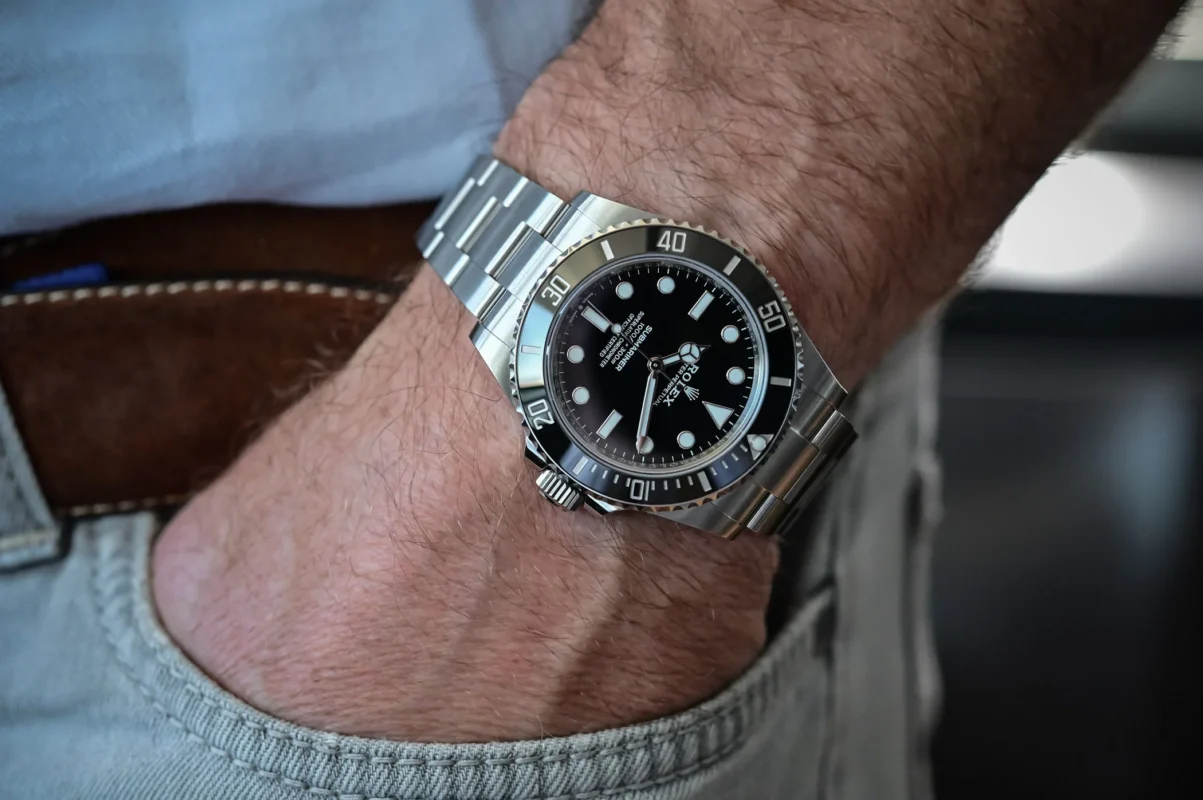
Here’s where we cross the $10,000 threshold, and the conversation changes. The Submariner is not just a dive watch — it’s the dive watch, the template against which every other underwater timepiece is measured. Introduced in 1953, it was one of the first watches waterproof to 100 meters. Today’s reference 124060, the no-date version in 41mm Oystersteel, is rated to 300 meters and carries a retail price of approximately $10,500.
That $10,500 figure deserves some context. In 2020, when Rolex debuted the current-generation 41mm Submariner, the no-date reference retailed at $8,100. Six years and several rounds of price increases later, you’re paying $2,400 more for the same fundamental watch. The movement got an upgrade (Calibre 3230 with a 70-hour power reserve versus the old 3135’s 48 hours), and the proportions were refined, but the sticker shock is real.
The real story is more nuanced than the retail price suggests. On the secondary market, the Submariner no-date typically trades at $11,000-$13,000, a modest premium over MSRP. That’s actually tame compared to the date-equipped version (reference 126610LN), which commands a larger premium because of higher demand. The no-date, sometimes called the “pure” Submariner by collectors who prefer the symmetry of a dial without a date window, is something of a value play in the steel sport Rolex world. Our Submariner collection includes dozens of references, including the specific Submariner 114060 and the 116610LN for comparison.
7. Pre-Owned Rolex Datejust “Wide Boy” — ~$5,500-$8,000
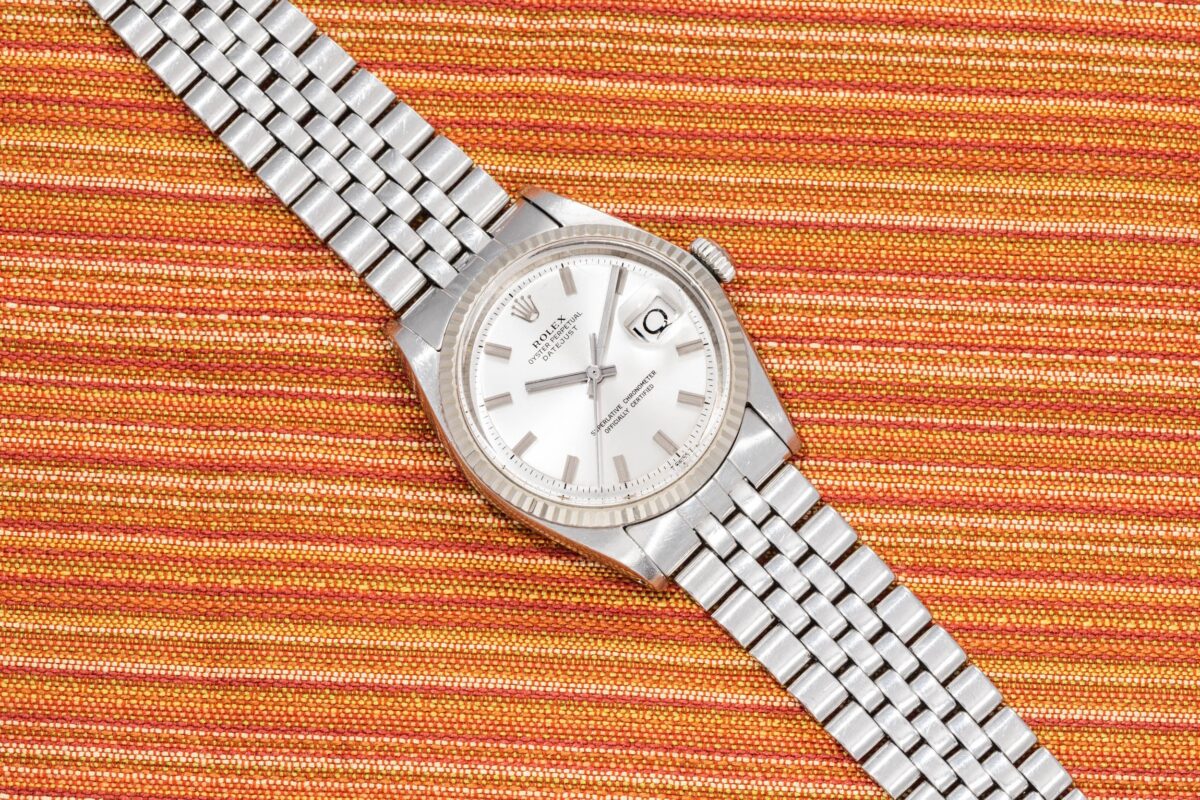
Here’s where we take a detour from current-production models and look at the pre-owned market, where the real bargains hide. The Datejust “Wide Boy” (typically reference 1601 or 1600) refers to a specific dial variation from the late 1960s through the 1970s with wider hour markers than the standard configuration. These watches carry the warmth and character that only five decades of patina can produce.
Prices for a decent Wide Boy hover between $5,500 and $8,000 depending on condition, dial variation, and whether it’s steel or two-tone. That’s Submariner-money for a watch with genuine vintage credibility. The 1601 with its engine-turned bezel and 18k yellow gold accents on a folded-link Jubilee bracelet is a particular favorite among collectors who appreciate the restrained elegance of an older Rolex.
There’s a contrarian argument worth making here: for less than the price of a new Oyster Perpetual, you can own a watch that has already absorbed its depreciation, carries decades of provenance, and will likely appreciate in value. Vintage Datejust prices have been remarkably stable compared to modern steel sports, which have been volatile. It’s the slow-food version of watch collecting — not flashy, but deeply satisfying.
8. Pre-Owned Rolex Datejust 36 Steel — ~$5,000-$7,000
If the Wide Boy feels too vintage for your taste, an earlier-generation Datejust 36 in steel (reference 116200 or the slightly older 16200) is one of the smartest buys in the entire Rolex ecosystem. These watches feature the same 36mm case proportions and timeless design as the current model, but without the 2026 retail markup.
On the pre-owned market, a clean 116200 with box and papers typically sells for $5,500-$7,000. You get the Calibre 3135 movement, which has been the workhorse of the Rolex lineup since 1988 and is one of the most thoroughly tested and refined automatic movements ever produced. It’s not the newest Calibre 3235, but it’s been proven reliable over decades of real-world use. The older movement’s 48-hour power reserve falls short of the current generation’s 70 hours, but unless you regularly leave your watch off for two days, you won’t notice.
This is the watch that savvy collectors point to when someone asks “what’s the best value in Rolex?” The 36mm Datejust in steel is understated, versatile, and immediately recognizable without screaming for attention. It’s the quiet confidence of the Rolex world.
What About the Milgauss and Cellini?
If you read our previous version of this guide, you’ll notice two models are missing from the 2026 list: the Milgauss and the Cellini. That’s because both have been discontinued. The Milgauss (last reference 116400GV, with the distinctive green sapphire crystal) was removed from the catalog, and remaining stock at authorized dealers has largely dried up. Pre-owned prices have actually risen as a result, with clean examples now commanding $10,000 or more — no longer a budget option.
The Cellini line was effectively replaced by the Perpetual 1908 dress collection, which starts above $22,000 in gold. That’s a different price bracket entirely. If you’re specifically looking for a dress Rolex on leather, the pre-owned Cellini market still offers options below $6,000 for older quartz references, but supply is limited and shrinking.
How Much Have Rolex Prices Actually Increased?
Let’s put some hard numbers behind the price evolution, because the increases compound in ways that surprise even seasoned collectors. According to Luxury Bazaar’s price tracking, here’s what the trajectory looks like for the key entry-level models:
Take the Oyster Perpetual 41 as a benchmark. In 2020, it launched at approximately $5,800. By late 2023, retail had reached $6,150. The 2025 increase pushed it to roughly $6,400. And the 2026 adjustment brought it to about $6,500. That’s a cumulative increase of roughly 12% over six years on one of Rolex’s most affordable references. Steel sport models like the Submariner saw even steeper climbs, with the no-date going from $8,100 in 2020 to approximately $10,500 in 2026 — a jump of nearly 30%.
The pattern is consistent: Rolex raises prices once or twice a year, usually in January and sometimes a mid-year adjustment focused on gold and two-tone models. Each individual increase is modest (3-6%), but they stack. Over a four-year horizon, the compounding effect is significant. The 2025 Rolex price increase analysis on our site breaks down exactly which models were hit hardest.
There’s also the tariff factor. The impact of trade policy on luxury watch pricing has become a genuine concern for US buyers, and our analysis of how tariffs affect Rolex prices is worth reading if you’re planning a purchase in 2026.
Frequently Asked Questions
What is the absolute cheapest Rolex you can buy new in 2026?
The Oyster Perpetual 28mm (reference 276200) is the cheapest current-production Rolex, with a retail price around $6,000. For most buyers, the 36mm or 41mm at approximately $6,500 is the more practical choice. If you’re willing to buy pre-owned, vintage Datejust models can be found for under $5,500.
Is the Rolex Oyster Perpetual worth buying?
Yes, the Oyster Perpetual is widely considered one of the best value propositions in the Rolex catalog. You get the same build quality, movement technology, and finishing as watches costing thousands more, just without complications like a date or rotating bezel. It’s also one of the few steel Rolex models that you can occasionally find at retail without a long wait.
Why are Rolex watches so expensive now compared to 2020?
Rolex has implemented annual price increases of 3-6% since 2020, and these compound over time. Additionally, supply constraints at authorized dealers have driven secondary market prices well above retail for popular models. Raw material costs (gold, in particular) have also contributed to steeper increases for precious metal and two-tone references.
Should I buy a new or pre-owned Rolex?
It depends on the model. For watches like the Explorer 36, which trades at or below retail pre-owned, buying second-hand can save you money. For hot models like the Submariner or popular Oyster Perpetual dial colors, you’ll likely pay above retail on the secondary market. Always verify authenticity and condition when buying pre-owned.
Is the cheapest Rolex a good investment?
No Rolex is a guaranteed investment, but entry-level steel models like the Submariner, Explorer, and Oyster Perpetual have historically held their value better than most luxury watches. The key is buying at the right price. Models purchased at heavy premiums over retail may take years to break even, while those bought at or near MSRP have a stronger value retention track record.
The Bottom Line
The cheapest Rolex in 2026 is a moving target. The Oyster Perpetual remains the gateway at around $6,000-$6,500, but even that figure has crept up by roughly $700 since 2022. The Explorer 36 at $7,900 offers perhaps the best value proposition in the current lineup, especially if you buy pre-owned. And for those willing to shop the vintage market, earlier-generation Datejust models deliver genuine Rolex quality and heritage for well under current retail prices.
What hasn’t changed is the fundamental value proposition. Even at $6,000, you’re getting a watch with in-house movement development, proprietary steel alloy, Superlative Chronometer certification, and a level of finishing that most brands can’t match at twice the price. The cheapest Rolex is still a Rolex — and that carries weight in a way that no marketing budget can replicate.
Ready to explore? Browse our complete collection of Rolex watches, or check out our guide on buying a cheaper Rolex for more money-saving strategies. If you’re still weighing your options, our Rolex Buyer FAQ covers the most common questions first-time buyers have.
Related Reading:
- What Are the Cheapest Rolex You Can Buy — our companion guide with additional budget options
- 18 Affordable Watches That Look Like Rolex in 2026 — great alternatives if even the cheapest Rolex is out of reach
- Rolex Reference Number Guide — learn to decode every reference number
- 12 Iconic Rolex Models and Their Purpose — understand the full Rolex lineup
- Rolex Discontinued Models 2026 — see which models Rolex dropped this year